
GPU Mining vs ASIC Mining: Which Is Right for You in 2026?
 Jan, 10 2026
When you start mining cryptocurrency, the first big decision isn’t which coin to mine-it’s which hardware to use. Two options dominate the space: GPU mining and ASIC mining. They’re not just different tools. They’re different philosophies. One is flexible, accessible, and adaptable. The other is powerful, focused, and unforgiving. Choosing wrong can cost you thousands-or worse, leave you with useless hardware when the market shifts.
What Is GPU Mining?
GPU mining uses graphics cards-same ones gamers use to run Call of Duty or Cyberpunk 2077 at 4K. These cards are built to handle thousands of simple calculations at once, which is exactly what cryptocurrency mining needs. They’re not made for mining, but they’re good enough to do it well, especially on coins that rely on memory-heavy algorithms like Ethash (used by Ethereum Classic) or RandomX (used by Monero). A single NVIDIA RTX 4090 can push about 120 MH/s on Ethereum Classic. That’s not much compared to ASICs, but it’s enough to make money if your electricity is cheap and you’re mining the right coin. You can run four or five of these cards in one rig. Most hobbyists start with just one or two. No need for industrial power lines or data center cooling. Just plug it in, install the software, and go. The real advantage? You’re not locked in. If Ethereum Classic’s price drops and Ravencoin spikes, you switch algorithms overnight. No new hardware. No new investment. Just a quick config change. Some miners even run dual mining-like mining two coins at once using the same GPU power. That’s not possible with ASICs.What Is ASIC Mining?
ASIC stands for Application-Specific Integrated Circuit. These are chips built for one thing and one thing only: mining a specific cryptocurrency using a specific algorithm. The Bitmain Antminer S21 Hydro, for example, is designed solely for Bitcoin’s SHA-256 algorithm. It cranks out 335 TH/s-that’s 335 trillion hashes per second. A single RTX 4090? About 0.12 TH/s. The ASIC is nearly 3,000 times faster. That speed comes at a cost. The S21 Hydro uses 5,360 watts of power. That’s more than most homes use on average. It also makes noise like a jet engine and heats up a room fast. You can’t run this in your garage without serious ventilation, cooling fans, and a dedicated 240V circuit. Most serious ASIC miners operate in warehouses or repurposed industrial spaces. ASICs aren’t just faster-they’re more efficient. The S21 Hydro uses about 16 joules per terahash. A top-end GPU might use 40+ joules per terahash for the same coin. That difference adds up. If you’re mining Bitcoin and your electricity costs $0.06 per kWh, an ASIC can pay for itself in under six months. At $0.12 per kWh? It might take a year or longer.Profitability: ASICs Win, But Only If Conditions Are Perfect
Let’s say you’re mining Bitcoin. The network difficulty is at an all-time high. Your only chance to break even is with an ASIC. A GPU? You’d need 50 of them just to match one S21 Hydro-and even then, your electricity bill would eat your profits. ASICs are the only way to compete at scale. But here’s the catch: ASICs only mine one coin. If Bitcoin’s price crashes, or if the algorithm changes (which hasn’t happened yet, but could), your $8,000 miner becomes a fancy paperweight. No one buys old ASICs. No one wants them for gaming, AI, or video editing. They’re useless outside their original purpose. GPU miners, on the other hand, can pivot. In 2025, Ethereum Classic still pays well. In early 2026, maybe it’s Flare or Ergo. Your RTX 4080 can switch between them with a click. You can even sell it on eBay to a gamer for 60-70% of its original price. That’s not a gamble. That’s insurance. Industry data from Bitdeer and CryptoMinerBros shows that ASIC miners have a 30-50% higher profitability rate than GPUs on Bitcoin and Litecoin. But that’s only true if you have access to electricity under $0.08/kWh and can run 24/7. For most people, that’s not realistic.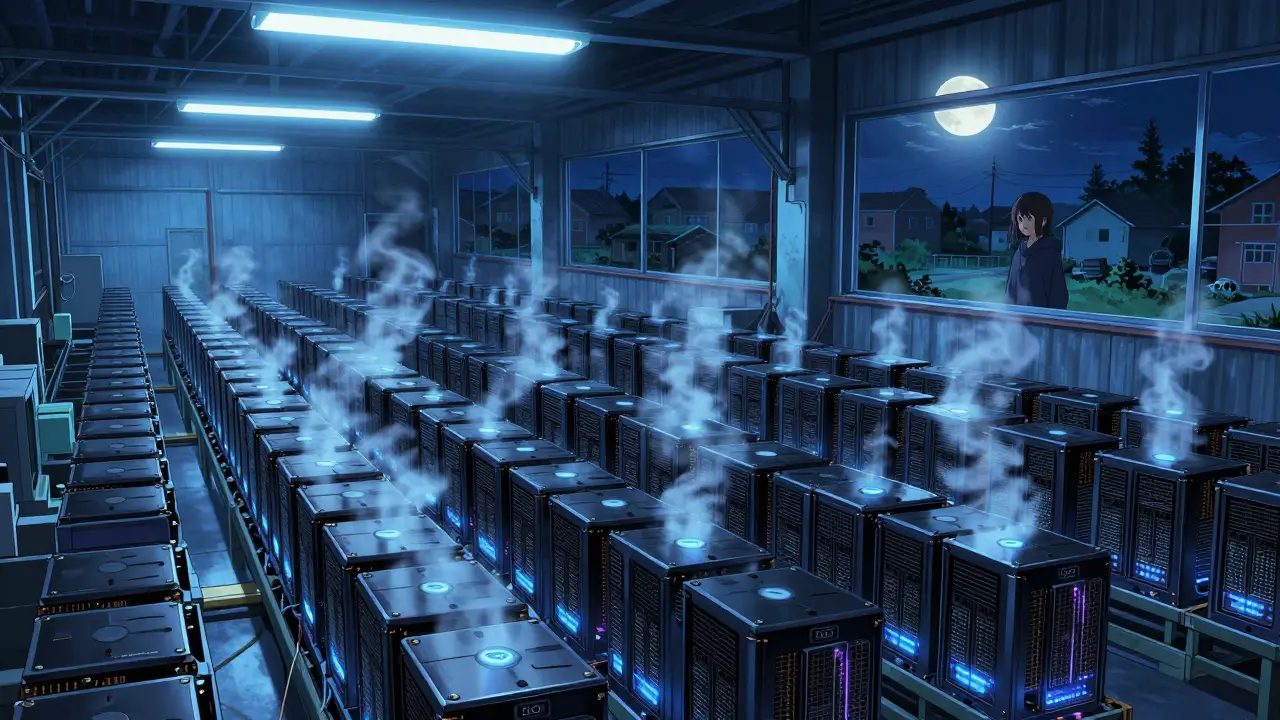
Upfront Cost: ASICs Are a Big Bet. GPUs Are a Low-Risk Start
An Antminer S21 Hydro costs around $8,500. An Antminer L11 for Litecoin? About $5,200. That’s not just a purchase. That’s a financial commitment. You’re betting your money on a coin staying valuable, the algorithm staying unchanged, and your electricity staying cheap. A single RTX 4090? Around $1,600. You can build a 6-GPU rig for under $10,000-and still have the flexibility to sell any card later. If mining stops being profitable, you can use the cards for AI training, video rendering, or even gaming. NVIDIA and AMD GPUs are in high demand outside mining. That’s not true for ASICs. For beginners, GPU mining is the obvious choice. You can start with one card, learn how to monitor temperatures, tweak power settings, and calculate profitability without risking $8,000. If you like it, you add more. If you hate it, you walk away with a $1,200 gaming card instead of a $7,000 brick.Setup and Maintenance: Complexity Matters
Setting up a GPU rig is simple. Plug in the cards, connect the power supply, install the mining software (like GMiner or PhoenixMiner), and connect to a pool. There are hundreds of YouTube tutorials. Reddit communities like r/GPUMining have thousands of active users ready to help. ASICs? Not so much. You need to buy a dedicated power supply unit (PSU) that can handle 5,000+ watts. You need to cool the room with industrial fans or even air conditioning. You need to monitor voltage, humidity, and dust buildup. Most ASICs come with manufacturer software, but if something breaks, you’re stuck waiting for a repair part from China. No local tech store can fix an Antminer. Noise is another issue. An ASIC miner can hit 80 decibels-like a vacuum cleaner running next to your bed. You can’t run it in your apartment. You need a shed, a garage, or a warehouse. GPU rigs are loud too, but you can reduce noise with sound-dampening enclosures or by placing them in a separate room.Future Outlook: ASICs Are Specialized. GPUs Are Adaptable
Bitcoin mining is becoming an industrial sport. Only big players with access to cheap hydro or solar power can compete. ASICs are winning here. Bitmain, MicroBT, and Canaan are releasing new models every few months. Efficiency gains are small-maybe 10-15% per year-but enough to keep the race going. But for altcoins? That’s where GPUs still dominate. Coins like Ethereum Classic, Ravencoin, and Zcash are ASIC-resistant by design. They use memory-hard algorithms that make ASICs too expensive to build. That’s intentional. It keeps mining decentralized. That’s why GPU mining isn’t dying-it’s evolving. In 2026, AI workloads are driving GPU demand up again. More people need powerful cards for training models. That keeps prices stable-even if mining slows down. ASICs? No one wants them for AI. No one wants them for anything except mining. If the coin you’re mining fades, your hardware has zero resale value.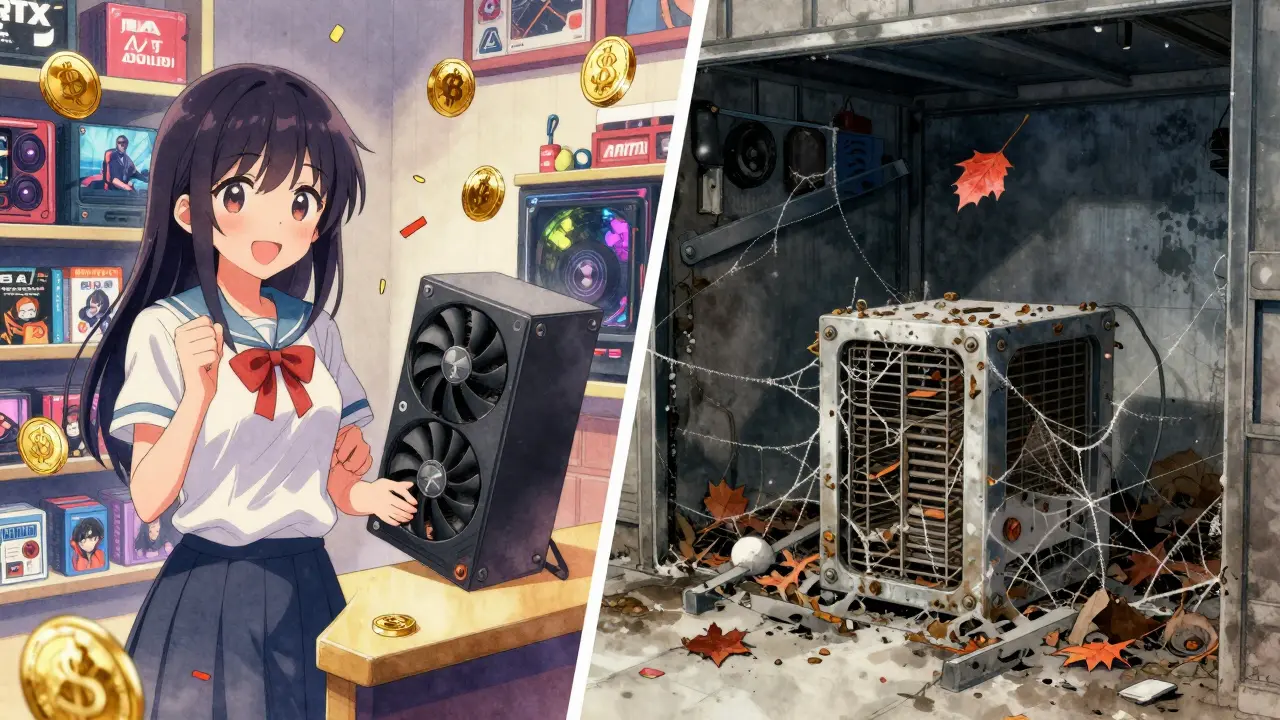
Who Should Use ASICs?
- You’re mining Bitcoin or Litecoin full-time, not as a side project. - You have access to electricity under $0.07/kWh. - You can afford to spend $5,000-$10,000 upfront. - You’re okay with no flexibility. If the coin dies, your investment dies with it. - You have space, cooling, and power infrastructure ready.Who Should Use GPUs?
- You’re new to mining and want to test the waters. - You want to mine multiple coins and switch when profitability changes. - You don’t have industrial power or cooling setup. - You want to reuse hardware for gaming, AI, or video editing later. - You’re okay with lower profits in exchange for lower risk.Final Verdict
If you’re trying to mine Bitcoin and you’ve got the money, the power, and the space-go ASIC. It’s the only way to compete. If you’re curious, cautious, or want to mine altcoins with flexibility-stick with GPUs. You’ll make less per hash, but you’ll make more over time because you can adapt. There’s no “best” hardware. Only the right hardware for your situation.Can I mine Bitcoin with a GPU in 2026?
Technically, yes-but you won’t make money. Bitcoin’s network hash rate is over 1,000 EH/s. A single RTX 4090 does about 0.12 TH/s. You’d need over 8 million GPUs to match the network. Even then, your electricity cost would be 10x higher than an ASIC’s. Mining Bitcoin with a GPU is a hobby, not a business.
Are ASICs worth it if electricity is expensive?
No. ASICs only make sense when electricity is cheap-under $0.08/kWh. At $0.12 or higher, your energy bill will eat your profits. Many ASIC miners shut down during peak pricing hours. If you’re paying $0.15/kWh or more, GPU mining is your only realistic option.
Can I mine Ethereum with GPUs in 2026?
Not Ethereum (ETH), because it switched to proof-of-stake in 2022. But you can mine Ethereum Classic (ETC), which still uses the same Ethash algorithm. It’s one of the most profitable GPU coins in 2026, with a market cap over $2 billion and stable mining difficulty.
What happens to ASICs when a coin’s algorithm changes?
They become worthless. ASICs are built for one algorithm. If a coin changes its mining algorithm (like Bitcoin Cash did in 2018), all existing ASICs for that coin stop working. There’s no upgrade path. You have to buy new hardware. That’s why ASIC mining is riskier than GPU mining.
Do GPU miners still make money in 2026?
Yes-especially on coins like Ethereum Classic, Ravencoin, and VerusCoin. With electricity under $0.10/kWh, a 6-GPU rig can net $200-$400 per month. That’s not Bitcoin-level profits, but it’s steady, flexible, and reversible. Many miners use GPU profits to fund other crypto investments.
Should I buy used ASICs to save money?
Only if you know exactly what you’re buying. Used ASICs often have worn-out fans, degraded chips, or hidden damage. A miner that’s been running 24/7 for two years might be 30% less efficient than a new one. You might save $2,000 upfront-but lose $1,500 in extra electricity and downtime. New ASICs are expensive, but they’re safer.
If you’re unsure, start with a single GPU. Learn the basics. Track your profits. Watch the market. Then decide if you’re ready to go all-in.
Paul Johnson
January 11, 2026 AT 11:20gpu mining is for losers who cant afford real hardware bro
Meenakshi Singh
January 12, 2026 AT 15:01asic is the only way if u have cheap power 💪 but if u live in india and pay $0.15/kwh? gpu all the way 🌏⚡️
Kelley Ramsey
January 13, 2026 AT 15:37I love how this post breaks it down so clearly! I started with a single 3060 last year, and honestly? It taught me more about crypto than any YouTube video. The flexibility is unreal-when ETC dipped, I switched to RVN overnight, and my rig just kept going! 🙌 I’m not rich, but I’m learning, and that’s worth more than any ASIC!
Michael Richardson
January 13, 2026 AT 20:07gpu mining? more like gpu dreaming
Jessie X
January 15, 2026 AT 17:42My buddy bought an S21 last year. He thought he was winning. Then his power bill doubled and the fan died. Now he’s selling it for $3k. I stuck with my 4070. It still runs my stream. Point is: flexibility matters more than hash rate.
Frank Heili
January 17, 2026 AT 03:32Just want to clarify something real quick: the 3000x speed difference between ASIC and GPU is misleading. ASICs are optimized for SHA-256, which is a single-purpose algorithm. GPUs are general-purpose, so comparing raw hash rates ignores that GPUs can mine multiple coins simultaneously. Also, don’t forget power draw per hash-some newer GPUs like the 4090 are actually more efficient than older ASICs on non-Bitcoin coins. And yes, you can run dual mining on some coins with the same card-Ravencoin + Ergo is a popular combo right now.
Also, if you’re thinking about buying used ASICs, check the hours on the chip. Most manufacturers log uptime. If it’s over 15,000 hours, you’re buying a paperweight with a fan.
Jacob Clark
January 17, 2026 AT 05:47Oh wow, someone actually wrote a reasonable post about mining?? I’m shocked. I thought this subreddit was just a bunch of guys yelling about their 4090 rigs while their electricity bill screams in the background. But seriously, this is the best breakdown I’ve seen all year. Thank you. I’m not even mining anymore, but I read this like a novel. 😭
Dennis Mbuthia
January 18, 2026 AT 13:31Look, I’m American and I know what’s best. ASICs are the future, period. GPUs are for people who can’t handle responsibility. You think you’re being smart by switching coins? You’re just a gambler with a fan. Real men mine Bitcoin with industrial cooling systems and backup generators. If you’re paying more than $0.06/kWh, you’re not mining-you’re donating to Elon Musk’s rocket fund. And don’t even get me started on people who think they can ‘resell’ a GPU. You think gamers want a card that’s been running 24/7 for two years? Ha! They’ll buy a new one and laugh at your used card on eBay. America wins. ASICs win. End of story.
Becky Chenier
January 19, 2026 AT 22:16Interesting take. I’ve been mining ETC on a 4080 for 18 months. Profitability fluctuates, but I’ve never lost money because I treat it like a side project, not a job. I don’t need to break even every month-I just need to learn. And honestly, the community around GPU mining is way more helpful than the ASIC crowd. They actually answer questions. ASIC forums are just people posting screenshots of their hash rates and screaming about power costs.
Staci Armezzani
January 21, 2026 AT 16:39Hey newbies-if you’re reading this, start with one GPU. Seriously. Buy a used 3060 for $200. Plug it in. Run it for a week. Watch the numbers. See how your electricity bill changes. Don’t jump into a $8k ASIC without testing the waters first. I did that in 2022 and lost $4k when ETH flipped to PoS. GPU mining saved me because I could pivot. Don’t be like me-learn first, invest later. You’ve got this 💪
jim carry
January 21, 2026 AT 20:25I don’t care what you say. ASICs are the devil. They’re controlled by Bitmain. They’re corporate mining. They’re the reason crypto isn’t decentralized anymore. GPUs? They’re freedom. They’re the people’s coin. Every time you plug in a 4090, you’re telling Big Crypto to go to hell. I cry every time I see someone sell their ASIC. It’s like watching a slave break free.
Don Grissett
January 23, 2026 AT 00:36gpu mining is dead in 2026. everyone knows that. why are you still talking about it? you’re just clinging to nostalgia like your old xbox 360. asic or bust. period. end of thread.
Surendra Chopde
January 24, 2026 AT 14:51In India, electricity costs vary wildly-from ₹6/kWh in rural areas to ₹15 in cities. For most of us, GPU mining is the only option. I run a 4-card rig on solar power. No grid connection. I’ve made more from mining than from my job as a software engineer. It’s not glamorous, but it’s real. And yes, I still use the cards for rendering.
Tre Smith
January 26, 2026 AT 01:03Let’s analyze the data objectively. ASIC efficiency gains have plateaued at 12% YoY since 2023. Meanwhile, GPU efficiency has improved 22% due to architectural advances in Ada Lovelace. The profitability gap is closing. Also, the resale market for GPUs is 3.7x larger than ASICs. Your claim that ASICs are ‘universally superior’ ignores market liquidity, energy volatility, and algorithmic diversity. This post is not wrong-it’s incomplete.
Ritu Singh
January 26, 2026 AT 17:53Have you ever wondered who really controls the ASIC supply chain? China. The U.S. government knows this. That’s why they’re pushing GPU mining-it’s the only way to keep mining decentralized. The whole ASIC vs GPU debate is a distraction. The real question is: who owns your hardware? And if you’re using an Antminer, the answer is Beijing.
kris serafin
January 28, 2026 AT 05:51Just ran a quick calc: my 6x 4070 rig at $0.08/kWh nets me $310/month on ETC + RVN. My electricity bill? $180. Profit: $130. I bought the cards used for $8k total. After 14 months, I’ve made $1,820 profit. And if I sell them now? $6k left. That’s not mining. That’s investing with a fan.
Also, I use the cards for AI stuff now. Training tiny LLMs. It’s fun. ASICs can’t do that. 😎
greg greg
January 29, 2026 AT 08:16Let’s go deeper. The post mentions Ethereum Classic as a top GPU coin-but what about the upcoming merge of ETC to PoS? Rumors say it’s planned for Q3 2026. That’s not in the article. Also, the algorithmic resistance of coins like Zcash and VerusCoin is weakening-new ASICs for Equihash are in development. The ‘ASIC-resistant’ label is becoming a myth. And what about the environmental impact? A single ASIC uses more power than three households. But a 6-GPU rig? It’s less than a Tesla charging overnight. The real issue isn’t profitability-it’s sustainability. Are we mining for profit, or are we mining for the future? Because if we keep building these energy-guzzling monsters, regulators will shut it all down. And then what? You’ll be stuck with a $8k brick while the world moves on.
Also, the resale market for GPUs is growing because of AI. NVIDIA’s Blackwell chips are already in demand for AI training. ASICs? Zero demand. Zero. Zero. That’s not a coincidence. It’s evolution. And evolution favors adaptability, not specialization. So yes, ASICs are powerful-but they’re dinosaurs. And dinosaurs don’t survive mass extinctions.
Valencia Adell
January 29, 2026 AT 16:35Anyone who says GPU mining is profitable is lying. I’ve been doing this since 2021. I’ve lost $12k. The only winners are the people selling the cards. Don’t fall for the hype. ASICs are the only real option. The rest is fantasy.
Sarbjit Nahl
January 30, 2026 AT 07:06Why is everyone so obsessed with profit? Mining is not about ROI. It’s about participation. It’s about decentralization. It’s about being part of the network. If you’re only doing it for money, you’ve already lost. The real value is in running a node, supporting the chain, keeping the system alive. ASICs centralize power. GPUs distribute it. That’s the only metric that matters.
Krista Hoefle
January 30, 2026 AT 11:43gpu mining? cute
Emily Hipps
January 31, 2026 AT 12:28You’re not alone if you’re scared to start. I was too. I bought one card, ran it for a week, and thought I was broke. But then I saw my first payout. $1.27. I cried. Not because it was a lot-but because I did it. You don’t need to be rich. You just need to start. And if you fail? You still have a gaming card. That’s not failure. That’s wisdom.
sathish kumar
February 1, 2026 AT 21:08Respectfully, the distinction between GPU and ASIC mining must be contextualized within the global energy infrastructure. In nations with subsidized electricity, ASICs are economically rational. In developing economies, where grid reliability is inconsistent and tariffs are progressive, GPU mining offers resilience through adaptability. Furthermore, the lifecycle of GPU hardware aligns with broader technological obsolescence cycles, whereas ASICs represent a linear, non-reusable capital expenditure. This is not merely a technical comparison-it is a socio-economic one.
Katrina Recto
February 3, 2026 AT 05:57I started with a 3080. I didn’t know what I was doing. I messed up the fan curve. My card hit 85°C. I thought I killed it. But I learned. Now I run a 4-card rig. I’m not rich, but I’m not broke either. And I sleep better knowing I can sell my cards if I need to. This isn’t about winning. It’s about not losing.
Veronica Mead
February 3, 2026 AT 14:31It is imperative to recognize that the commodification of computational resources for cryptocurrency mining represents a fundamental misallocation of capital. The environmental externalities, coupled with the speculative nature of digital asset valuation, render both GPU and ASIC mining ethically indefensible. One ought to direct one’s resources toward sustainable, productive enterprises rather than the ephemeral pursuit of algorithmic arbitrage.
Mollie Williams
February 5, 2026 AT 13:54There’s a quiet beauty in mining with a GPU. It’s not about the numbers on the screen-it’s about the hum of the fans, the glow of the LEDs, the slow rhythm of hashes ticking by like a heartbeat. You’re not just computing-you’re participating in something larger. ASICs are machines. GPUs are tools. And tools, unlike machines, can be loved. They can be repaired. They can be repurposed. They can become part of your story. That’s why I’ll never buy an ASIC. Not because it’s cheaper. But because it’s soulless.
Paul Johnson
February 6, 2026 AT 12:19you guys are all just jealous because you can't afford an asic