
Kimchi Premium and Korean Crypto Market Explained: Why Bitcoin Costs More in South Korea
 Feb, 16 2026
Have you ever wondered why Bitcoin costs nearly 10% more in South Korea than anywhere else in the world? It’s not a glitch. It’s not a scam. It’s the kimchi premium-a persistent, real-world anomaly that’s been shaping how crypto moves in and out of one of the most active digital asset markets on the planet.
Imagine this: Bitcoin trades at $45,000 on Binance, Coinbase, or Kraken. But in Seoul, on UpBit or Bithumb, the same Bitcoin is selling for $49,500. That 10% gap? That’s the kimchi premium. And it’s not new. It’s been around since 2016, long before most people had heard of DeFi or NFTs. While global markets move in sync, South Korea’s crypto market runs on its own rhythm-tied not to Bitcoin’s global supply, but to local demand, strict rules, and money that can’t move freely.
What Exactly Is the Kimchi Premium?
The term comes from Korea’s famous fermented cabbage dish-spicy, pungent, and unmistakably local. Just like kimchi has a flavor you won’t find anywhere else, the price of crypto in South Korea has a unique markup you won’t see on other exchanges.
The math is simple: take the price on a Korean exchange, subtract the global average price, then divide by the global price. Multiply by 100. That’s your premium percentage. In January 2018, it hit 55%. Bitcoin was $10,000 in the U.S. and $18,000 in Seoul. Traders salivated at the idea of buying low and selling high. But here’s the catch: actually doing it? Almost impossible.
Why? Because the Korean market isn’t open for arbitrage. It’s locked down.
Why Does the Premium Exist?
Three things keep the kimchi premium alive: demand, restrictions, and behavior.
First, demand. South Korea has one of the highest rates of crypto ownership in the world. A 2025 survey by the Korea Financial Intelligence Unit showed over 12% of adults hold crypto-more than in the U.S. or Japan. People aren’t just buying Bitcoin. They’re buying Solana, Ethereum, even obscure altcoins on day one of listing. That kind of hunger pushes prices up fast. And supply? Limited. Korean exchanges don’t have the same liquidity as Binance or Coinbase. When 50,000 people rush to buy a new token, prices spike overnight.
Second, restrictions. The Korean government doesn’t want money flooding in and out of crypto markets like water through a broken dam. So they put up walls. Transferring funds from a Korean bank to an overseas exchange takes 3-7 business days. Wire transfers are scrutinized. Withdrawals over $10,000 require extra paperwork. And forget using foreign bank accounts to buy crypto-you need a Korean ID and local address to open an exchange account. That blocks international traders cold. No arbitrage. No price alignment.
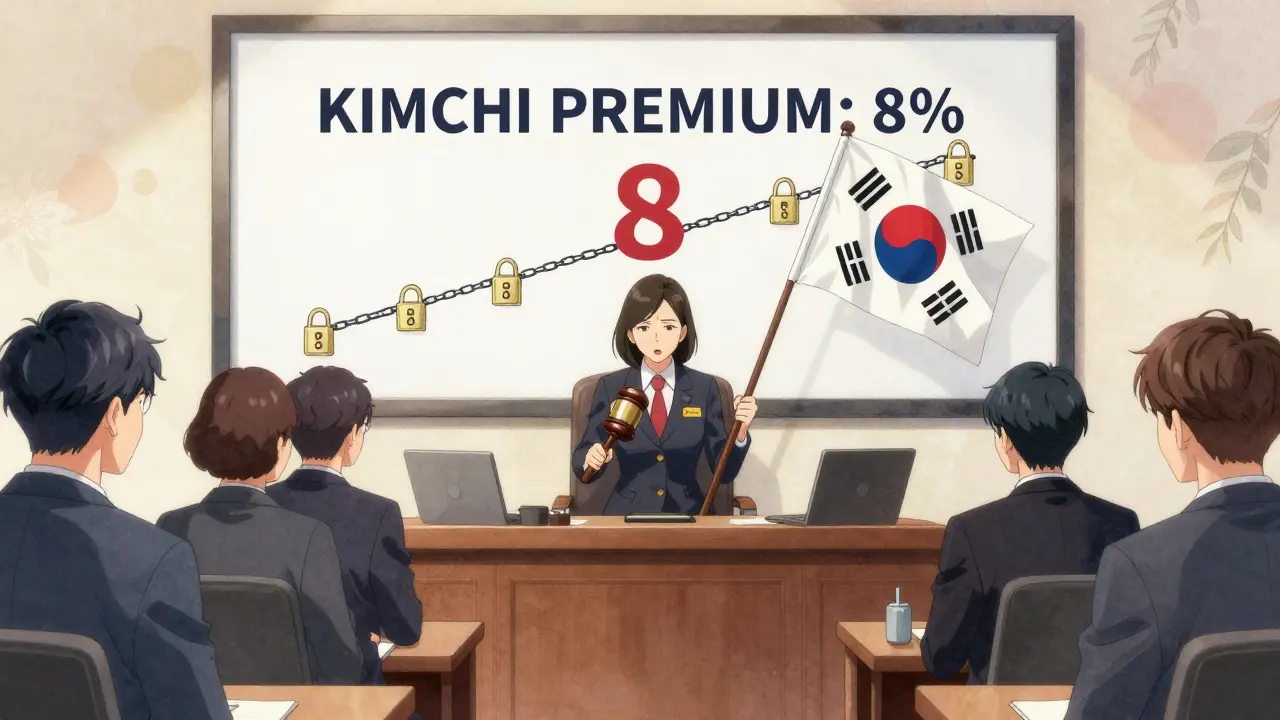
Third, behavior. Korean traders are aggressive. When Bitcoin drops 5% globally, they buy more. When a new coin lists on UpBit, prices jump 30% in hours. It’s not just speculation-it’s a cultural habit. Many traders treat crypto like a lottery ticket. And when the market gets wild, the premium grows. During the 2021 bull run, premiums spiked again. In late 2024, after a major regulatory announcement, the premium jumped from 2% to 8% in 48 hours. Why? Because traders panicked and bought more, assuming the government might ban trading soon.
Why Can’t Traders Just Profit From It?
You’d think this is a free money opportunity. Buy Bitcoin in the U.S., sell it in Korea. Profit. But reality is messier.
First, you can’t open a Korean exchange account unless you live there. No foreign passport. No virtual address. No luck. Second, even if you somehow got in, moving money out takes days. By the time you sell and try to withdraw, the premium has vanished. Third, Korean exchanges limit withdrawals to $10,000 per day. You can’t move millions. Fourth, taxes and fees eat into profits. Korean exchanges charge 0.15% per trade. International transfers cost $30-$100. And if you’re caught trying to bypass rules? Your account gets frozen.
There have been attempts. In 2022, a group of U.S.-based traders tried using peer-to-peer platforms to buy Korean crypto via local middlemen. They got shut down within weeks. The Financial Services Commission fined them and flagged their bank accounts. The message was clear: don’t try to game the system.
How Do Korean Regulators Keep It Going?
The government doesn’t want the premium. They’ve tried to kill it. Multiple times. In 2019, they banned anonymous trading. In 2021, they forced exchanges to report all user transactions to the tax office. In 2023, they introduced mandatory KYC for every single wallet address linked to an exchange.
But here’s the irony: every rule they make to stabilize the market ends up reinforcing the premium.
Why? Because stricter rules mean fewer foreign players. Fewer foreign players mean less liquidity. Less liquidity means prices get pushed up by local buyers alone. The more they try to fix it, the more they lock it in.
Compare this to the U.S. or Europe. There, crypto is regulated, but money moves fast. You can buy Bitcoin on Coinbase, withdraw to your bank, and have cash in 24 hours. In Korea? It’s a maze. That’s not a bug-it’s a feature of their financial system.
What’s the Impact Beyond Korea?
The kimchi premium isn’t just a local oddity. It’s a warning sign for the whole crypto world.
It shows that even in a decentralized system built for global access, national laws can still create walls. Bitcoin is supposed to be borderless. But in practice, your wallet’s value depends on where you live.
Regulators in Japan, Canada, and Australia watch Korea closely. When the premium spikes, they ask: “Could this happen here?” Some have started limiting how fast crypto can be bought with local currency. Others have delayed new exchange listings to avoid a rush.
For traders, the premium is a signal. When it rises above 5%, it often means Korean demand is overheating. That can be a sign of a broader market top. When it drops below 1%, it means either global prices are rising fast-or Korean traders have lost interest.
Some hedge funds now track the kimchi premium daily. They don’t trade it. They use it as a sentiment indicator. If the premium suddenly collapses, it might mean Korean investors are pulling out-possibly because of new regulations or a looming crash.

Is the Premium Going Away?
Not anytime soon.
Global adoption is rising. More institutions are entering crypto. But Korea’s system hasn’t changed. Capital controls are still in place. Local demand is still high. Exchanges still require local IDs. And the culture of speculative trading? Still strong.
Even in 2025, when institutional Bitcoin ETFs are running in the U.S., the kimchi premium still shows up after major news events. In December 2025, after a leaked draft of new tax rules, the premium jumped to 7.2% in one day. Traders rushed to buy, fearing limits on future trading. The government didn’t change the rules-but the market reacted anyway.
The kimchi premium isn’t going away because it’s not a flaw. It’s a feature of a market that’s both deeply engaged and tightly controlled. It’s the price you pay for a country that loves crypto but refuses to let it go free.
What Should You Do With This Info?
If you’re trading crypto globally, keep an eye on the Korean market. Use tools like CoinGecko or CryptoCompare to compare prices between Binance and UpBit. If the premium jumps above 5%, it might mean a short-term price spike is coming in Korea. But don’t try to exploit it. You’ll get blocked, delayed, or fined.
If you’re in Korea, understand that your crypto prices aren’t broken-they’re shaped by forces beyond your control. The premium reflects your market’s energy, not its inefficiency.
And if you’re just curious? This is one of the clearest examples of how real-world rules still shape digital markets. Bitcoin may be code. But its price? Still human.
What causes the kimchi premium to rise and fall?
The kimchi premium rises when demand in South Korea surges-usually during bull markets, new coin listings, or regulatory uncertainty. It falls when global crypto prices rise faster than local ones, or when the government eases capital controls. Speculative trading, tax changes, and even social media trends can trigger sudden spikes.
Can international investors profit from the kimchi premium?
Practically, no. To profit from it, you’d need to buy crypto in Korea and sell it abroad. But Korean exchanges require local residency and ID verification to open an account. International transfers take days, and withdrawal limits are strict. Any attempt to bypass these rules risks account freezes or legal action by Korean authorities.
Is the kimchi premium unique to Bitcoin?
No, but Bitcoin is the most tracked. The premium also exists for Ethereum, Solana, and other major cryptocurrencies traded on UpBit and Bithumb. However, Bitcoin’s price is more stable and widely reported, so it’s the standard benchmark. Altcoins often show even larger premiums due to lower liquidity and higher speculation.
How does the Korean government respond to high premiums?
The government doesn’t directly target the premium, but it responds to the conditions that cause it. When premiums spike, regulators often tighten KYC rules, delay new exchange listings, or increase reporting requirements. They’ve never removed capital controls-because they believe those controls protect the broader financial system, even if they preserve the premium.
Do other countries have similar crypto price gaps?
Occasionally, yes-but nothing as consistent as Korea. In 2022, Nigeria saw temporary premiums during capital controls. Venezuela had spikes during hyperinflation. But none have lasted as long or been as tightly linked to national policy. Korea’s combination of high demand, strict rules, and limited foreign access makes its premium a unique, long-term phenomenon.
kieron reid
February 17, 2026 AT 19:51Ian Plunkett
February 19, 2026 AT 19:31Avantika Mann
February 21, 2026 AT 18:00yogesh negi
February 23, 2026 AT 06:11Nikki Howard
February 24, 2026 AT 22:52Tarun Krishnakumar
February 26, 2026 AT 15:52jennifer jean
February 27, 2026 AT 07:24Sasha Wynnters
February 28, 2026 AT 10:49george chehwane
March 2, 2026 AT 04:53Charrie VanVleet
March 3, 2026 AT 22:52Scott McCrossan
March 5, 2026 AT 15:33Beth Erickson
March 6, 2026 AT 16:28Jenn Estes
March 7, 2026 AT 23:47Anandaraj Br
March 8, 2026 AT 01:30AJITH AERO
March 9, 2026 AT 02:17Geet Kulkarni
March 10, 2026 AT 18:17