
Privacy in Decentralized Identity: Taking Back Control of Your Data
 Apr, 12 2026
Think about every time you've created an account online. You likely handed over your email, birthdate, and maybe a phone number to a company you'll never meet, trusting them to keep it safe in a giant database. The problem is that these databases are essentially honey pots for hackers. When a massive company gets breached, your personal details are leaked in bulk because you didn't actually own your identity-they did. Decentralized Identity is a framework that shifts the power from central authorities back to the individual, using distributed ledgers to manage who has access to your personal information. By removing the middleman, it solves the core problem of digital trust.
How Decentralized Identity Actually Works
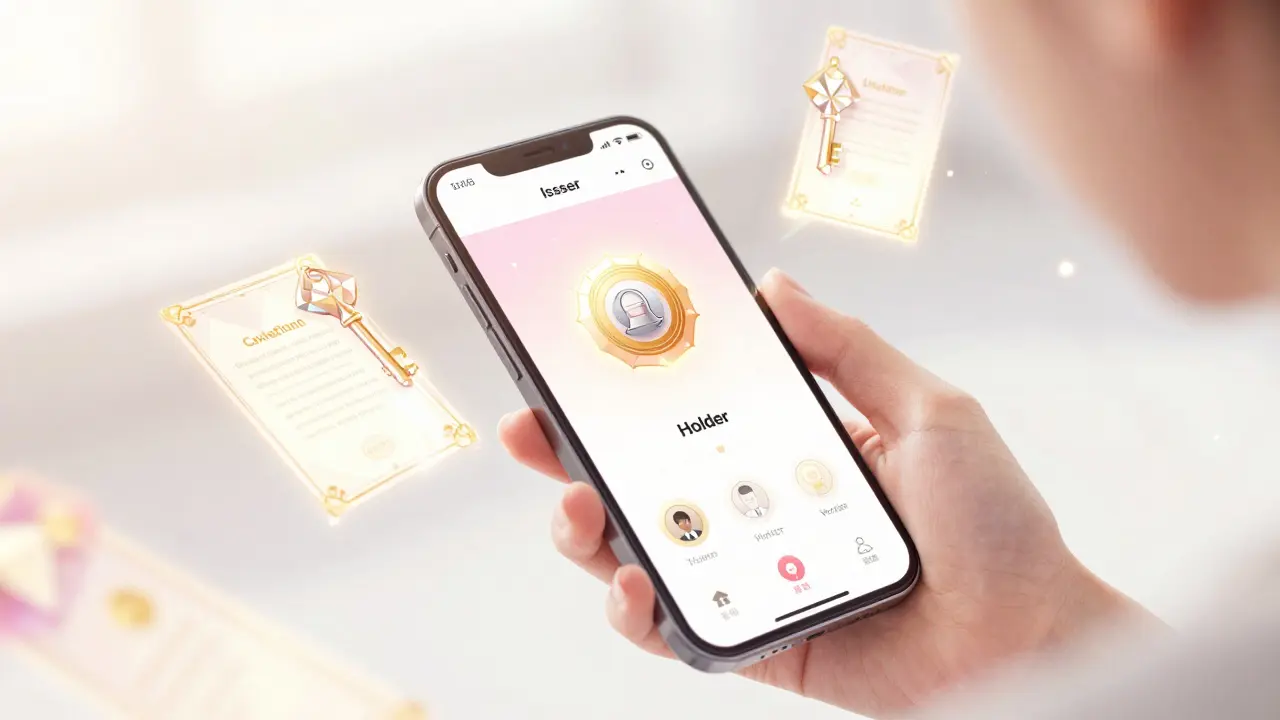
In the old system, if you need to prove you're over 21, you show a physical ID that also reveals your home address and exact birthdate. That's way too much information. Decentralized identity fixes this by splitting the process into three specific roles: the issuer, the holder, and the verifier.
- The Issuer: This is an entity like a government or a university. They don't store your data in a cloud for others to see; instead, they give you a digital certificate.
- The Holder: That's you. You keep these certificates in a Digital Wallet, which is a secure app on your phone. You hold the keys; the company doesn't.
- The Verifier: This is the party asking for proof-like a liquor store or a bank. Instead of calling the issuer to check your records, they check a cryptographic signature on the blockchain to see if the certificate is real.
The Secret Sauce: DIDs and SSI
You can't have privacy without a way to identify yourself without using your name. That's where Decentralized Identifiers (or DIDs) come in. A DID is just a long string of random letters and numbers. Unlike an email address, it doesn't tell anyone who you are or where you live. It's simply a pointer to a public key on a network.
This is the foundation of Self-Sovereign Identity (or SSI). This isn't just a technical feature; it's a philosophy. SSI means you are the sole owner of your digital persona. You decide exactly what pieces of data to share and for how long. If a service no longer needs your data, you can simply revoke their access, which is nearly impossible with traditional accounts.
Blockchain: The Trust Layer Without the Exposure
A common misconception is that your private data is stored directly on the blockchain. If that were true, your privacy would be gone forever because blockchains are public and immutable. In reality, Decentralized Identity uses a clever "off-chain" approach.
Your actual personal details-your name, address, and Social Security number-stay inside your encrypted wallet on your own device. Only the Blockchain is used to store the DID and the public key of the issuer. When you present a credential, the verifier uses the blockchain to confirm the issuer's signature is valid. This means the blockchain acts as a witness to the truth without ever actually seeing the data it's witnessing.
| Feature | Centralized Identity (Web2) | Decentralized Identity (Web3) |
|---|---|---|
| Data Storage | Centralized Server (Honeypot) | User's Local Device (Distributed) |
| Control | Company-owned | User-owned (Self-Sovereign) |
| Verification | Querying the central database | Cryptographic proof via Blockchain |
| Data Leak Risk | High (Single point of failure) | Low (No central target) |
Selective Disclosure and Zero-Knowledge Proofs
The real magic of privacy in this space is called "selective disclosure." Imagine you're applying for a loan and the bank needs to know you earn over $50k a year. In the traditional world, you send a PDF of your tax return, revealing every single detail of your finances. With Verifiable Credentials, you can share just the specific claim that is needed.
This is often powered by Zero-Knowledge Proofs (ZKPs). A ZKP allows you to prove that a statement is true without revealing the information itself. For example, you can prove "I am over 18" without revealing your date of birth. You aren't giving them a piece of data; you're giving them a mathematical proof that the data meets their criteria. This is the gold standard for privacy-by-design.

Practical Steps: How to Use This Today
Moving to a decentralized model isn't as simple as switching an app, but the transition is happening. Here is how the workflow typically looks for a regular person:
- Set up a Wallet: You download a compatible identity wallet that generates your unique private and public key pairs.
- Request Credentials: You ask an issuer (like your employer) to send a digitally signed credential to your wallet.
- Store Securely: The credential sits on your device, encrypted. You don't need to trust a cloud provider to keep it.
- Share on Demand: When a service asks for ID, you select only the required attributes (e.g., "Confirmed Resident of New Zealand") and send the proof.
The Roadblocks and Future Outlook
It sounds perfect, but there are still hurdles. The biggest one is interoperability. If the government uses one standard for DIDs and your bank uses another, the system breaks. We need a global agreement on how these identifiers talk to each other.
There's also the "key management" problem. In a decentralized world, if you lose the private key to your identity wallet and don't have a backup, you effectively lose your digital existence. There is no "Forgot Password" button when there is no central server. This is why current research is focused on social recovery methods-where a few trusted friends can help you regain access to your identity without needing a central company.
Is my personal data actually on the blockchain?
No. In a properly designed decentralized identity system, your personal data is stored locally in your digital wallet. The blockchain only stores the Decentralized Identifier (DID) and public keys used to verify that your credentials are authentic. This prevents your private information from being publicly visible or permanently etched into the ledger.
What happens if I lose my digital wallet?
Because you hold the private keys, losing your wallet without a backup can be serious. However, most modern systems use recovery phrases (seed phrases) or social recovery, where designated guardians can help you re-establish your identity. It is critical to back up your recovery keys in a secure, offline location.
How is this better than a government ID card?
A physical ID card forces you to reveal all your information (name, address, DOB) just to prove one thing (like age). Decentralized identity allows for selective disclosure via Zero-Knowledge Proofs, meaning you only share the specific piece of information required for the transaction and nothing more.
Who issues the credentials in a decentralized system?
Credentials are issued by trusted entities, known as Issuers. These can be governments for passports, universities for degrees, or companies for employee badges. The difference is that once they issue the credential, they no longer control it; it lives in your wallet, and you decide when to show it.
Can a company still track me if I use a DID?
It's much harder. Since you can generate different DIDs for different services, you prevent companies from easily linking your activities across the web. You aren't using a single "Global ID" (like a Google or Facebook login) that allows them to track your behavior across every site you visit.
Jason Davis
April 13, 2026 AT 11:24The concept of ZKPs is basically a game changer for how we handle ssensitive data. Most people dont realize that the actual math allows you to prove a statement is true without sharing the underlying data at all
I've seen some implementatons where this reduces the risk of idenity theft by almost 90% since there is no longer a central honey pot to hit.
Kieran Smith
April 13, 2026 AT 18:02This is wild stuff! I wonder how long it will take for the average person to actually get on board with this. Most people just want thing's to be easy, even if it means giving away their privacy.
daniella davis
April 15, 2026 AT 06:48Ugh please. As if anyone actually believes goverments will just hand over the keys to our identity. Like, hello? They love their control way too much to actually let SSI happen. This is just fantasy land lol.
Heather Warren
April 16, 2026 AT 07:53It is very helpful to see the comparison table. I think it makes the transition from Web2 to Web3 much easier to understand for everyone.
Swati Sharma
April 17, 2026 AT 12:18The synergy between the holder and the verifier is truly a paradigm shift in the trust architecture. Integrating a robust interoperability layer will definitely be the catalyst for mass adoption of these verifiable credentials.
7stargee Emmanuel Obani
April 18, 2026 AT 18:23Blockchain is just a buzzword for people who want to get rich quick 🙄
Hope Johnson
April 19, 2026 AT 04:28When we contemplate the essence of ownership in a digital age, we must realize that identity is not merely a collection of data points but a reflection of our autonomy within a structured society, and by reclaiming this, we are essentially engaging in a philosophical reclamation of the self against the encroaching tide of corporate surveillance that has defined the last two decades of our internet experience, which is why the movement toward self-sovereignty is so vital for the future of human dignity.
Lela Singh
April 20, 2026 AT 01:06Absolutely electric! This is the future of data freedom!
Kelly Cantrell
April 21, 2026 AT 09:38Just what they want. Another way for the globalists to track us using 'mathematical proofs' that we can't even see. Once the government issues these 'digital certificates,' they can just flip a switch and erase your existence from the network. It's a trap to get us away from physical IDs that they can't remotely deactivate.
Agnessa Dale
April 22, 2026 AT 23:39I'm really hopeful that this will make the internet a safer place for everyone!
Emily H
April 23, 2026 AT 04:44The implementation of the 'off-chain' approach is a commendable architectural decision, as it ensures that sensitive personal identifiable information remains under the user's direct control while leveraging the blockchain for verification purposes.
Will Dixon
April 24, 2026 AT 17:21sounds cool but i bet most people will still lose there keys lol
Jonathan Chamma
April 26, 2026 AT 05:18It's like having a magic key that only shows what you want people to see. Truly a wonderful way to protect ourselves!
Scott Fenton
April 27, 2026 AT 05:33One must emphasize that the security of the local device becomes the primary point of failure in this model. Therefore, utilizing hardware-backed security modules is an absolute necessity for any serious implementation.
Stanly Hayes
April 28, 2026 AT 03:11Get with the program! This is how we stop these tech giants from treating our lives like a product for sale!
Lane Montgomery
April 29, 2026 AT 11:07Which wallet app are you using?
EDOZIEM MICHAEL
April 30, 2026 AT 14:33true power is owning your own truth without needing a witness
jennelle williams
May 2, 2026 AT 10:13less sharing is more peace
Lauren Abrams
May 3, 2026 AT 02:29The part about selective disclosure is interesting. It seems logically sound to reduce the amount of exposed data.
Terrance Hausmann
May 4, 2026 AT 10:26I totally agree that the social recovery part is the most critical piece of the puzzle here because without it the risk of total data loss is simply too high for the average consumer to accept, regardless of the privacy benefits.
Surender Kumar
May 5, 2026 AT 04:20nice read man, really helps to see it broken down like this
aletheia wittman
May 5, 2026 AT 11:57omg imagine losing your whole life because you forgot a password!! i would literally scream lol
Kieran Smith
May 6, 2026 AT 00:31right? that's what i was thinkin. total nightmare scenario.