
Russian Sanctions and Crypto Exchange Access Limitations: Garantex, Grinex, and A7A5
 Jun, 30 2026
Imagine trying to move money online, only to find your account frozen, your access blocked, and the platform you trusted suddenly declared illegal by foreign governments. For millions of users in Russia and other sanctioned jurisdictions, this is not a hypothetical scenario-it is daily reality. The landscape of Russian sanctions and cryptocurrency exchange access has shifted dramatically since early 2024, turning what was once a relatively open digital frontier into a high-stakes game of cat and mouse.
The core problem is simple but severe: traditional financial channels like SWIFT have been largely cut off for Russian banks. This forced many individuals and businesses toward cryptocurrencies as a lifeline. However, Western governments, particularly the United States, have responded with aggressive enforcement actions targeting the very infrastructure that facilitates these transactions. If you are looking to understand how these restrictions work, which exchanges are banned, and what alternatives exist, you need to look beyond the headlines. You need to understand the specific entities, tokens, and legal mechanisms driving this crackdown.
The Fall of Garantex and the Rise of Grinex
To understand the current limitations, we must first look at Garantex, a major cryptocurrency exchange founded by Sergey Mendelev, Aleksandr Mira Serda, and Pavel Karavatsky. For years, Garantex served as one of the primary on-ramps and off-ramps for Russian users trading fiat currency for crypto. It was designated by the U.S. Department of the Treasury's Office of Foreign Assets Control (OFAC) back in April 2022 under Executive Order 14024. But the situation escalated significantly in March 2025.
In a coordinated international operation led by the U.S. Secret Service, law enforcement seized three Garantex domains, confiscated servers, and froze over $26 million in cryptocurrency. Crucially, they arrested co-founder Aleksej Besciokov in India. This wasn't just a technical disruption; it was a decapitation strike on the platform's leadership. When Garantex went dark, its users were left stranded. Their funds were locked in wallets they could no longer access through the official interface.
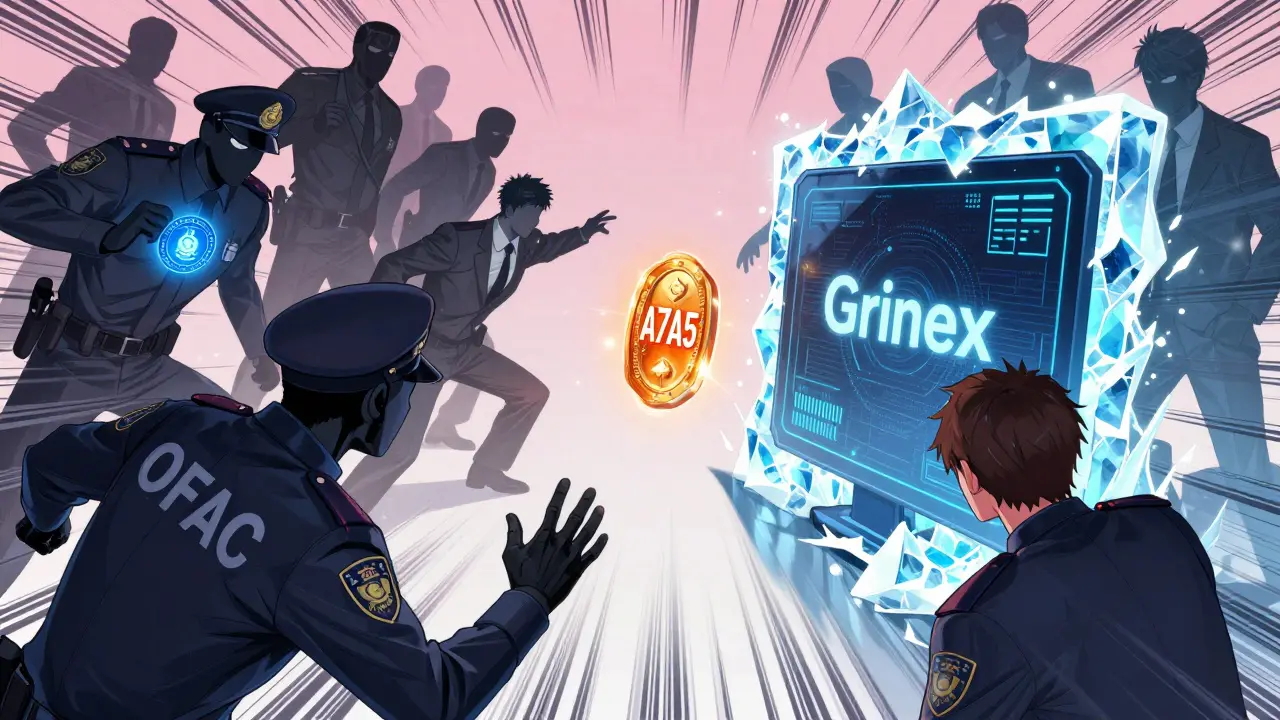
This is where Grinex, the successor exchange created by Garantex employees to circumvent sanctions enters the picture. Almost immediately after the March 2025 seizure, Garantex staff launched Grinex. Its promotional materials explicitly stated it was formed in response to the sanctions and asset freezes affecting Garantex. The goal was clear: allow existing customers to regain access to their accounts. However, the U.S. government did not wait long to respond. On August 14, 2025, OFAC re-designated Garantex and simultaneously sanctioned Grinex, alleging it was owned or controlled by the blocked entity. This move effectively closed the door on the most obvious workaround for former Garantex users.
The Role of A7A5 and the 'A7' Network
If Grinex was the platform, then A7A5, a ruble-backed digital asset issued by a Kyrgyzstani firm to facilitate transactions was the fuel. With traditional stablecoins like Tether's USDT becoming risky due to centralized freezing capabilities, the A7 network emerged as a resilient alternative. The A7 network includes several associated companies such as A7, A71, A7 Agent, Old Vector, Independent Decentralized Finance Smartbank and Ecosystem (InDeFi Bank), and Exved.
Blockchain analytics firm Elliptic revealed in August 2025 that companies linked to this 'A7' network had received approximately $8 billion in cryptocurrency transactions since early 2024. This figure represents a conservative lower bound, suggesting the actual volume is likely higher. The A7A5 token was designed specifically to help users bypass sanctions after domestic banks were cut off from SWIFT. It allowed users to maintain value stability relative to the ruble while operating outside the direct control of Western-controlled financial infrastructure.
| Entity | Type | Status (as of Aug 2025) | Key Risk Factor |
|---|---|---|---|
| Garantex | Crypto Exchange | Sanctioned (OFAC) | Domain seizure, leadership arrest, fund freezes |
| Grinex | Successor Exchange | Sanctioned (OFAC) | Linked to Garantex ownership/control |
| A7A5 | Stablecoin/Token | Monitored by Analytics Firms | Used for sanction evasion, potential key compromise |
| USDT (Tether) | Stablecoin | Restricted/Centralized | Wallets can be frozen by issuer |
How Blockchain Analytics Enable Enforcement
You might assume that cryptocurrency offers anonymity. In practice, it offers pseudonymity, and sophisticated analytics firms are dismantling that layer of privacy. Elliptic’s investigation highlighted how Garantex employed complex wallet obfuscation techniques to avoid detection. They used methods to mix funds and obscure transaction trails, making it difficult for regulators to trace illicit flows.
However, Elliptic managed to overcome these obfuscation methods. By analyzing patterns and linking wallets to known entities, they provided actionable intelligence to the U.S. Secret Service. This data directly enabled the freezing of $26 million in USDT. More recently, Elliptic added support for screening A7A5 transactions on both TRON and Ethereum blockchains. This means that even if you switch to a less common token like A7A5, your movements are still visible to compliance tools used by global exchanges and financial institutions.
The 'A7 leaks' that became public in mid-2025 further exposed the vulnerability of these networks. These leaks disclosed information allowing cryptocurrency wallets to be linked directly to A7 companies. Evidence suggests that infrastructure changes observed in August 2025 may have been a reaction to a security breach that potentially compromised cryptographic keys. Unusual activity with A7A5 stablecoin wallets around August 14, 2025-the same day OFAC announced new sanctions-indicates that the entities were actively scrambling to adapt to enforcement pressures.
Legal Mechanisms: Executive Orders and Rewards
The legal framework behind these restrictions is robust and expanding. The initial designation of Garantex in 2022 was pursuant to Executive Order 14024, which targets the financial services sector of the Russian Federation economy. The August 2025 actions expanded this scope. OFAC designated Garantex and Grinex pursuant to EO 13694, as amended by EOs 14144 and 14306. This broader authority allows the U.S. to target individuals and entities involved in malicious cyber activities and sanctions evasion globally.
Beyond blocking assets, the U.S. government is using financial incentives to disrupt leadership. Simultaneously with the August 2025 designations, the U.S. Department of State announced financial rewards totaling up to $6 million for information leading to the arrest or conviction of Garantex's leaders. Specifically, there is a reward of up to $5 million for Aleksandr Mira Serda. This approach aims to create internal pressure within these organizations, encouraging whistleblowers and complicating operational continuity.

Implications for Users and Businesses
For the average user in Russia or other sanctioned regions, the message is clear: accessing crypto exchanges carries significant risk. Traditional platforms are systematically targeted. Successor platforms like Grinex are quickly identified and sanctioned. Even alternative tokens like A7A5 are being monitored and integrated into compliance screening tools.
If you are a business considering partnerships with entities in these regions, due diligence is critical. The 'A7' network involves multiple companies across Russia and the Kyrgyz Republic. Engaging with any of these entities could expose you to secondary sanctions. The scale of transactions-$8 billion since early 2024-shows that this is not a niche issue but a major component of the regional financial ecosystem.
The volatility of the ruble also plays a role. Users previously favored USDT for its price stability compared to the volatile ruble. However, the centralized nature of USDT became a liability when Garantex was forced offline. The shift to A7A5 was an attempt to mitigate this, but as Elliptic’s updates show, no solution is truly invisible to modern blockchain analysis.
Future Outlook: An Evolving Battlefield
The timeline of events suggests an escalating conflict. From the initial 2022 sanctions to the March 2025 seizure and the August 2025 expansion, the U.S. strategy has evolved from targeting single entities to dismantling entire ecosystems. The timing of the August 2025 sanctions also aligns with broader geopolitical developments, including statements from President Trump regarding potential further economic sanctions against Russia if ceasefire negotiations fail.
As enforcement capabilities improve, the barriers to entry for legitimate crypto usage in sanctioned regions will continue to rise. New platforms will emerge, new tokens will be created, and new obfuscation techniques will be developed. But the window for safe, unrestricted access is closing rapidly. The combination of OFAC sanctions, State Department rewards, and private-sector blockchain analytics creates a multi-pronged defense that is increasingly effective.
For those relying on these systems, the key takeaway is resilience through diversification and awareness. Relying on a single exchange or token is dangerous. Understanding the legal status of the platforms you use is essential. And recognizing that blockchain transparency is a double-edged sword-it enables innovation but also enables unprecedented levels of surveillance and enforcement-is crucial for navigating this complex landscape.
Is Garantex still operational?
No, Garantex is not operational in its original form. Following domain seizures and server confiscations in March 2025, and subsequent OFAC sanctions in August 2025, the platform has been effectively shut down. Attempts to access it may lead to frozen funds or legal risks.
What is Grinex and why was it sanctioned?
Grinex is a cryptocurrency exchange created by former Garantex employees to serve as a successor platform after Garantex was disrupted. It was sanctioned by OFAC in August 2025 because it was deemed to be owned or controlled by Garantex, a blocked person, and was facilitating transactions to evade sanctions.
What is the A7A5 token?
A7A5 is a ruble-backed digital asset issued by a Kyrgyzstani firm, part of the broader 'A7' network. It was developed as an alternative to USDT to help users bypass sanctions and maintain value stability. However, it is now monitored by blockchain analytics firms like Elliptic.
Can I use USDT safely in sanctioned regions?
Using USDT in sanctioned regions carries significant risk. While widely used, USDT is centrally controlled by Tether, which can freeze wallets at the request of authorities. Many users have lost access to their USDT holdings when exchanges like Garantex were sanctioned or shut down.
Who are the key figures behind Garantex?
The key figures include Sergey Mendelev (co-founder), Aleksandr Mira Serda (co-founder and CCO), and Pavel Karavatsky (co-owner). All three were sanctioned by OFAC in August 2025. Additionally, co-founder Aleksej Besciokov was arrested in India in March 2025.
How much money has flowed through the A7 network?
According to Elliptic's August 2025 analysis, companies linked to the A7 network have received approximately $8 billion in cryptocurrency transactions since early 2024. This figure is considered a conservative lower bound.
Are there rewards for information on Garantex leaders?
Yes, the U.S. Department of State announced rewards totaling up to $6 million for information leading to the arrest or conviction of Garantex leaders. This includes a specific reward of up to $5 million for Aleksandr Mira Serda.
Why did the U.S. target cryptocurrency exchanges?
The U.S. targeted cryptocurrency exchanges because they became critical infrastructure for circumventing traditional financial sanctions, such as SWIFT cuts. By controlling these platforms, the U.S. aims to halt the flow of illicit funds, including ransomware proceeds, and enforce broader economic restrictions on Russia.