
Social Tokens vs NFTs: Key Differences, Use Cases & Value Explained
 Jul, 31 2026
You’ve probably seen the headlines. A musician drops a token that lets fans buy backstage passes. An artist sells a digital painting for millions. Both involve crypto wallets and blockchain technology, but they are not the same thing. Confusing social tokens with Non-Fungible Tokens (NFTs) is one of the most common mistakes new users make in the web3 space. One is about community access; the other is about unique ownership. Getting this wrong can lead to bad investment choices or missed opportunities for creators.
By July 2026, the distinction has become even sharper. The market has moved past the hype cycle, and users now demand clear utility. If you are looking to support a creator, join a community, or invest in digital assets, understanding the fundamental difference between these two asset classes is essential. This guide breaks down exactly how they work, who should use them, and why their value drivers are completely different.
The Core Difference: Fungibility vs. Uniqueness
To understand the split between social tokens and NFTs, you need to grasp one concept: fungibility. In simple terms, something is fungible if it can be exchanged for something else of equal value without any loss. Think of a $10 bill. You can swap your $10 bill for someone else’s $10 bill, and it doesn’t matter which specific piece of paper you hold. The value remains identical.
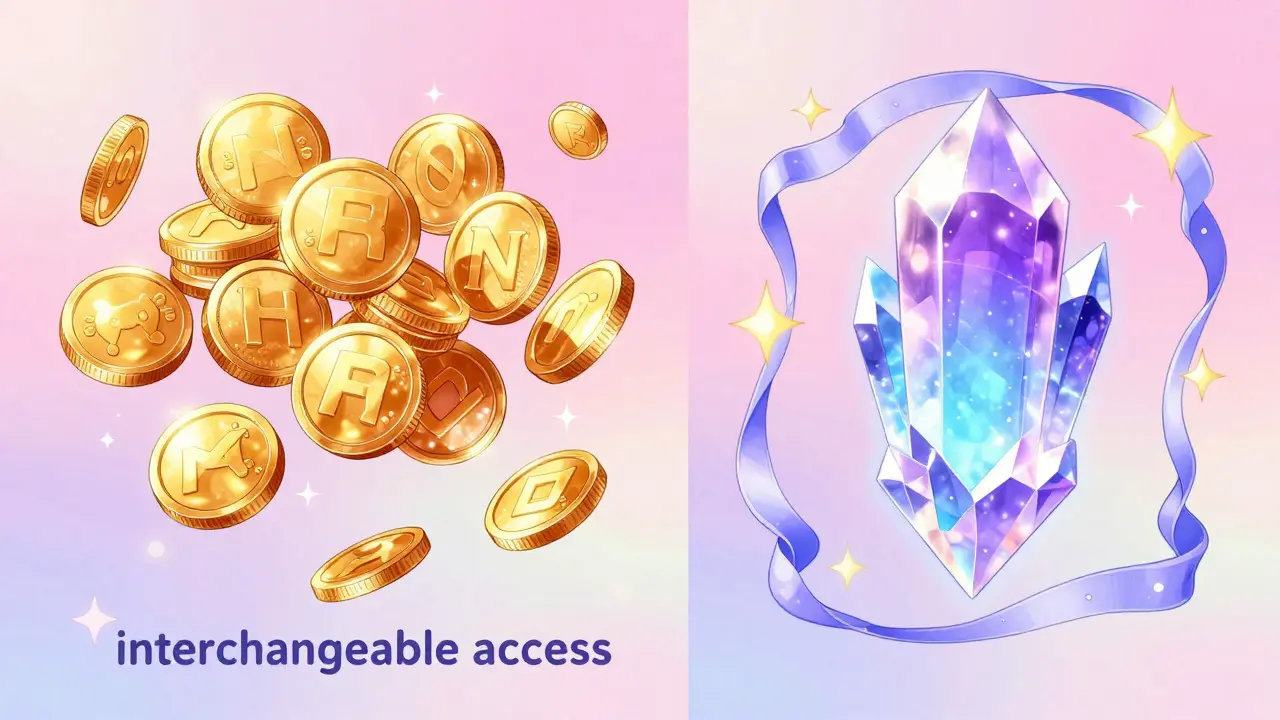
Social tokens are fungible digital assets that represent access to experiences, communities, or relationships with creators. They operate on a 1:1 exchange basis. If you hold five units of a specific creator’s social token, each unit holds the same value and grants the same level of access as the others. They function similarly to traditional currencies or loyalty points within a specific ecosystem.
NFTs, on the other hand, are non-fungible. Each token is unique, indivisible, and distinct from every other token. You cannot swap one NFT for another and expect them to have the same value or utility. An NFT representing a rare digital artwork by Beeple is fundamentally different from an NFT representing a common profile picture. This uniqueness is what drives the scarcity model in the NFT market.
How Social Tokens Work in Practice
Social tokens emerged as a way to deepen the relationship between creators and their audiences. Unlike traditional subscription models where you pay a platform like Patreon, social tokens give holders a direct stake in the creator’s success and often provide governance rights or exclusive access.
There are three main categories of social tokens:
- Personal or Creator Tokens: Issued by individuals such as musicians, influencers, or athletes. For example, Sting launched a social token that allowed fans to support his music directly and access exclusive content. Similarly, Polish pop star Doda created tokens that gave fans private daily updates. These tokens turn fandom into a tangible economic interaction.
- Community Tokens: Designed to strengthen groups or collectives. Holders might get voting rights in decision-making processes or membership access to private channels. The Shiba Inu community is a prime example, issuing tokens that grant access to private Telegram groups. Crucially, if a member leaves the community, they can sell their token, providing liquidity to the holder.
- Platform Tokens: Used to encourage participation on specific platforms or ecosystems. These often serve as the currency for transactions within a decentralized application (dApp).
The key benefit here is accessibility. Because social tokens are fungible, they can be bought in small fractions. A fan doesn’t need to spend thousands to support an artist; they can buy a few dollars worth of tokens. This lowers the barrier to entry significantly compared to many high-value NFTs.
The Mechanics and Value of NFTs
Non-Fungible Tokens (NFTs) are unique digital certificates of ownership built primarily on the Ethereum blockchain using standards like ERC-721. They represent ownership of one-of-a-kind digital assets, including artwork, music, domain names, gaming items, and virtual real estate.
The value of an NFT is subjective and driven by rarity, desirability, and cultural significance. When a rare NFT sells for millions, it isn’t because the file itself costs millions to produce. It’s because the market perceives that specific token as scarce and desirable. This makes NFTs powerful tools for proving provenance and ownership in a digital world where copying files is trivial.
NFTs excel in scenarios requiring exclusivity. Digital artists use them to monetize their work directly. Gamers use them to own in-game items that can be traded outside the game environment. Collectors use them to build portfolios of digital memorabilia. However, this uniqueness comes with complexity. Each NFT requires individual metadata management and often custom smart contract development, leading to higher transaction costs and technical barriers for creators.

Technical Architecture and Costs
Under the hood, the technical differences explain why these assets behave so differently. NFTs are primarily built on the Ethereum blockchain using the ERC-721 standard. This standard ensures that each token has a unique identifier, making it impossible to replicate. While robust, this structure creates higher gas fees (transaction costs) and greater complexity due to the need for individual asset management.
Social tokens, being fungible, utilize standard token frameworks that support batch transfers and unified contracts. This makes them far more cost-effective and scalable. If a creator wants to send rewards to 10,000 fans, sending fungible tokens is computationally cheaper and faster than minting and transferring 10,000 unique NFTs. This efficiency is why social tokens are better suited for large-scale community engagement and loyalty programs.
| Feature | Social Tokens | NFTs |
|---|---|---|
| Fungibility | Fungible (interchangeable) | Non-Fungible (unique) |
| Primary Value Driver | Access, community, utility | Scarcity, ownership, rarity |
| Technical Standard | ERC-20 (typically) | ERC-721 or ERC-1155 |
| Transaction Cost | Lower (batch processing) | Higher (individual minting) |
| Best Use Case | Loyalty programs, memberships | Digital art, collectibles, gaming assets |
| Valuation Clarity | Clear exchange rates | Subjective, market-driven |
Use Cases: Where Each Asset Type Excels
Choosing between a social token and an NFT depends entirely on your goal. Are you trying to build a recurring revenue stream and a loyal community? Or are you trying to sell unique digital property?
Social tokens shine in building ongoing engagement. They enable decentralized autonomous organizations (DAOs) to govern themselves through voting. They create loyalty programs that reward long-term participation rather than one-off purchases. For companies, they offer new compensation methods and supporter engagement tools. Fans get a voice in online communities, while creators get steady income streams. The clarity of exchange rates also makes social tokens more understandable for mainstream users who are wary of the volatile pricing often seen in NFT markets.
NFTs dominate in areas requiring provable ownership. If you are a digital artist, an NFT allows you to sell your work with a certificate of authenticity that lives on the blockchain. If you are a gamer, an NFT ensures that the sword you earned in-game is truly yours and can be sold to another player. Virtual real estate projects rely on NFTs to define plot boundaries and ownership rights. The premium nature of NFTs makes them ideal for exclusive experiences that social tokens cannot replicate due to their fungible nature.
Risks and Regulatory Considerations
Neither asset type is without risk. As of 2026, regulatory uncertainty still looms over both sectors. Experts warn that social tokens may be prime targets for digital asset scammers due to their perceived simplicity. The legality of social tokens varies by jurisdiction, with some regulators viewing them as securities depending on how they are marketed and used.
NFTs face different challenges. The market has seen significant volatility, and many projects have failed after the initial hype faded. Valuation is highly subjective, meaning an NFT could lose most of its value overnight if interest wanes. Additionally, the environmental impact of proof-of-work blockchains (though largely mitigated by Ethereum’s shift to proof-of-stake) remains a concern for some users, though layer-2 solutions and alternative chains have reduced energy consumption significantly.
Due diligence is critical. For social tokens, check the team behind the project and the actual utility offered. For NFTs, verify the contract address and the reputation of the creator. Never invest more than you can afford to lose in either category.
Future Trends: Convergence and Hybrid Models
The lines between social tokens and NFTs are beginning to blur. Industry analysts note a rise in hybrid approaches. Artists might sell an NFT of their physical artwork while simultaneously offering a social token that grants access to online workshops or private streams. This combines the ownership model of NFTs with the access model of social tokens.
This evolution suggests a future where comprehensive creator economy solutions integrate both asset types. Social tokens provide the scalable infrastructure for community management and micro-transactions, while NFTs offer the prestige and scarcity for premium offerings. Creators who leverage both can maximize their reach and revenue, catering to casual fans with affordable social tokens and serious collectors with exclusive NFTs.
As blockchain technology matures, we will likely see more seamless interoperability between these assets. Imagine buying a social token that automatically upgrades to an NFT after reaching a certain holding threshold, granting additional perks. Such innovations will further embed these digital assets into the fabric of the internet, moving beyond speculation toward genuine utility.
Can I convert a social token into an NFT?
Not directly. Social tokens are fungible and interchangeable, while NFTs are unique. However, some platforms allow you to "burn" a certain number of social tokens to mint a unique NFT, effectively converting access-based value into ownership-based value. This is a manual process defined by the specific smart contract of the project.
Which is better for investing: social tokens or NFTs?
It depends on your risk tolerance and goals. Social tokens generally offer lower entry prices and clearer utility, making them potentially safer for community engagement. NFTs can offer higher returns due to scarcity but come with greater volatility and subjectivity in valuation. Neither is guaranteed to appreciate in value, and both carry significant market risks.
Are social tokens legal?
The legality of social tokens varies by country and depends on how they are structured. In some jurisdictions, they may be classified as securities if they promise profit based on the efforts of others. Always consult local regulations and consider seeking financial advice before purchasing social tokens, especially those tied to revenue sharing or governance rights.
Do I need a crypto wallet to use social tokens or NFTs?
Yes. To hold, trade, or interact with either social tokens or NFTs, you need a compatible cryptocurrency wallet. Popular options include MetaMask, Coinbase Wallet, or Phantom, depending on the blockchain network (e.g., Ethereum, Solana) where the assets are issued. Ensure your wallet supports the specific token standard (ERC-20 for social tokens, ERC-721 for NFTs).
What happens if a social token project fails?
If a social token project loses relevance or the creator stops providing utility, the token’s value can drop to near zero. Unlike fiat currency, there is no central bank to backstop social tokens. Holders may find it difficult to sell their tokens if liquidity dries up. This highlights the importance of researching the long-term viability of the project before investing.