
VPN Usage for Crypto in Iran: Detection Risks for Traders
 Jan, 8 2026
Iranian crypto traders aren’t just buying Bitcoin or Ethereum-they’re fighting to stay connected to the global market. With domestic banks blocked from handling crypto transactions and international exchanges like Binance and Coinbase actively blocking Iranian IPs, the only way many can trade is through a VPN. But using a VPN isn’t a safe hack anymore. It’s a high-stakes game where a single dropped connection can mean losing everything.
Why VPNs Are the Only Option
The Central Bank of Iran bans banks from processing cryptocurrency payments. That means no local wire transfers, no credit card buys, no PayPal. To buy crypto, Iranians need access to foreign exchanges. But those exchanges detect Iranian IP addresses and lock accounts before you even log in. So traders turn to VPNs. Not just any VPN-these are specialized, underground services that do more than hide your IP. They supply fake foreign IDs, foreign bank accounts (IBANs), and even SIM cards to receive SMS verification codes. Without all three, you’re locked out.In 2025, Iranian users moved $3.7 billion in crypto between January and July. That’s down from 2024, but still massive. And over 87% of that activity flowed through Nobitex, Iran’s largest exchange. But even Nobitex isn’t safe anymore. In October 2024, blockchain analytics firms started publicly listing wallet addresses linked to Nobitex and offering bounties for identifying users. Suddenly, your wallet wasn’t just visible-it was tagged.
The Detection Trap: When Your VPN Fails
The biggest risk isn’t getting caught using a VPN. It’s what happens when the VPN drops.Picture this: You’re on Binance, sending ETH to a cold wallet. Your connection glitches. Your IP flashes back to Tehran for 3 seconds. The exchange’s system flags it. Within minutes, your account is frozen. No warning. No appeal. You’re locked out, and your coins are stuck.
Free VPNs make this worse. Many don’t even use strong encryption. Some sell your data to third parties. Others are so overloaded with Iranian users that they slow to a crawl-making trades impossible during volatility. And exchanges don’t just look at your IP anymore. They use device fingerprinting: your browser version, screen resolution, installed fonts, even how fast you type your password. Combine that with transaction timing-like always trading after 10 PM Tehran time-and you’re easily spotted.
How Exchanges Are Catching Iranians
Binance didn’t always block Iranians. Back in 2019, all you needed was an email. Iranian users flooded in. Staff reportedly joked internally about "IRAN BOYS" in chat logs. But after October 2021, Binance upgraded its KYC system. Suddenly, millions of Iranian accounts vanished overnight.Today, detection is automated and multi-layered. Blockchain analytics firms like Chainalysis and Elliptic track transaction patterns. Iranian traders tend to use the TRON network heavily-over $2 billion of Nobitex’s $3 billion in 2025 flowed through TRON. That’s not random. TRON is cheaper and faster for small transfers, but it’s also easier to trace. When 90% of transactions from a certain region use the same token and follow the same withdrawal pattern, it’s like leaving a trail of bread crumbs.
Even more alarming: Iranian users now show up in global fraud databases. A 2025 report showed Iranian-linked wallets had a 0.9% illicit activity rate-same as the global average. But because of the volume and the political context, every Iranian transaction gets extra scrutiny. It’s not about guilt. It’s about association.

The Underground Economy: Fake IDs and Fake Banks
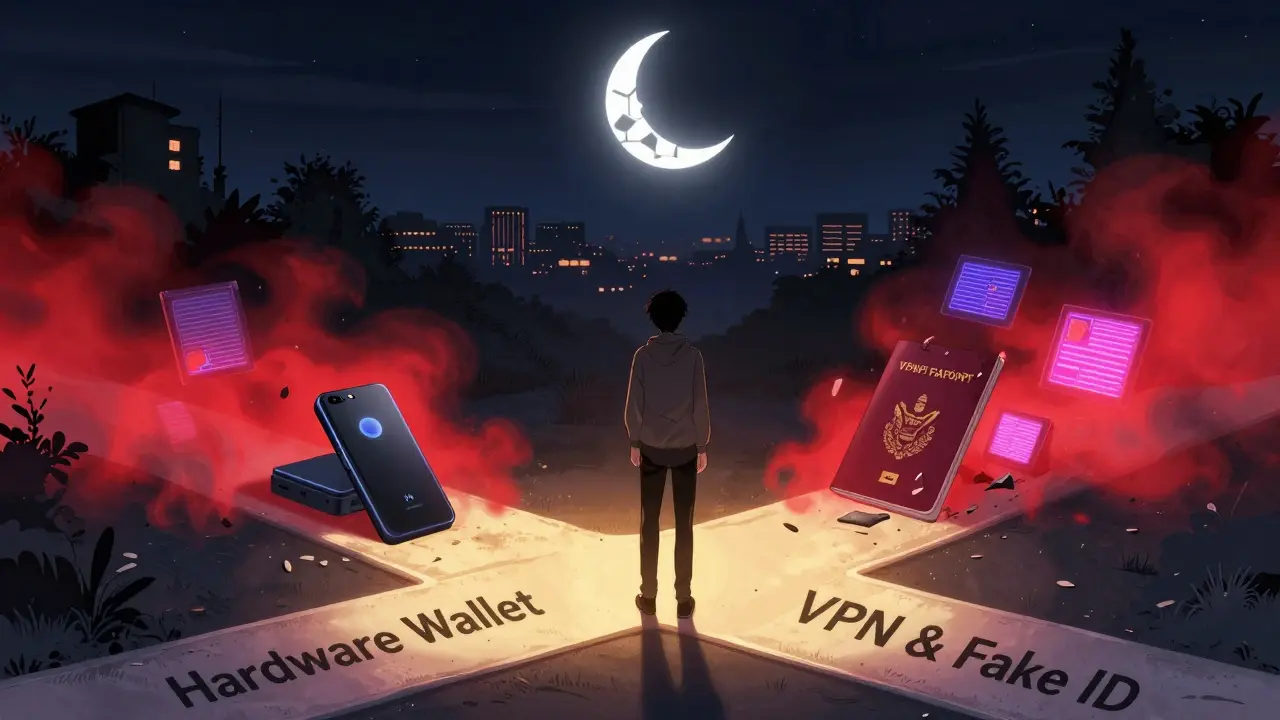
When the system cracks down, people adapt. In Tehran, a black market has grown around crypto circumvention. For $150-$300, you can buy a full identity package: a fake Canadian or Turkish passport, a foreign bank account with real IBAN details, a SIM card from a European country, and a pre-configured VPN that auto-switches if your connection drops. Some services even include fake utility bills to prove "residency."These aren’t hackers. They’re teachers, mechanics, and students-ordinary people trying to protect their savings from inflation. One trader in Mashhad told Reuters he spent six months building his fake German ID. He lost $18,000 in ETH when his VPN provider got shut down. He’s still trying to recover it.
These services are risky. Many are scams. Some collect your real ID documents and sell them to other criminals. Others disappear after one payment. There’s no regulation. No recourse. You’re on your own.
What Happens When You Get Caught
In January 2025, Iran’s Cyber Police (FATA) froze over one million bank accounts tied to crypto activity. Some were linked to domestic exchanges like Nobitex. Others were tied to foreign platforms where users had used fake IDs. The Central Bank didn’t charge people with crime-they just cut off access. No trial. No notice. Just silence.For many, it wasn’t just money lost. It was trust destroyed. Nobitex, once seen as a lifeline, was exposed for sharing user data with state agencies. After that, users started moving funds out-fast. But moving crypto out of Iran is harder than ever. Exchanges now flag withdrawals to Iranian wallets, even if they’re routed through multiple chains.
Alternatives Are Limited
Some traders turned to Hamster Combat, a mobile game that pays small amounts of crypto for daily play. It’s not a replacement for trading-it’s a side hustle. Others use peer-to-peer platforms like LocalBitcoins, but those are slow, risky, and often targeted by scammers. Mining? Only licensed miners can legally sell their coins, and they’re forced to sell to state-approved buyers at fixed rates-far below market value.There’s no clean solution. Even if you use the best VPN, the best fake ID, and the most secure wallet, you’re still playing Russian roulette. Every update from an exchange, every new blockchain analytics tool, every government crackdown makes it harder.
The Future Is Bleaker
By June 2025, crypto inflows to Iran dropped over 50% year-over-year. In July, the drop hit 76%. That’s not just market fatigue. That’s detection working. The bounty programs targeting Iranian wallets are expanding. More exchanges are integrating real-time geolocation checks. Even Tor networks are being monitored now.The Iranian government isn’t trying to stop crypto. It’s trying to control it. Licensed miners? Allowed. Private traders using VPNs? Illegal. And the tools to catch them are getting smarter every month.
If you’re still trading crypto in Iran using a VPN, you’re not just circumventing rules-you’re operating in a war zone. The stakes aren’t just financial. They’re personal. One mistake, one dropped connection, one compromised service-and your life savings could vanish without a trace.
Is using a VPN to trade crypto in Iran illegal?
Technically, yes. While Iran doesn’t have a law that says "using a VPN for crypto is banned," the Central Bank prohibits all cryptocurrency transactions by individuals, and the Cyber Police actively pursue those who bypass internet restrictions. Using a VPN to access foreign exchanges falls under illegal circumvention of state controls. Enforcement is inconsistent, but penalties can include bank account freezes, asset seizures, and in extreme cases, criminal charges.
Can I get my crypto back if my exchange account is frozen?
Almost never. International exchanges like Binance, Kraken, or Coinbase have zero obligation to help Iranian users. Once flagged, accounts are frozen permanently. Appeals are ignored. There’s no customer service line for users from sanctioned regions. Your only hope is if you transferred funds to a wallet you control before the freeze-but even then, withdrawing to a bank is impossible.
Are free VPNs safe for crypto trading in Iran?
No. Free VPNs are among the riskiest options. Many log your activity, sell your data, or inject malware. In Iran, where every transaction is monitored, using a free VPN could mean your wallet address, IP, and transaction history are sold to intelligence firms or government agencies. Paid services are risky too-but at least they’re less likely to be outright malicious.
Why do so many Iranian traders use the TRON network?
TRON is cheap, fast, and easy to use for small transfers. Transaction fees are fractions of a cent, and confirmations take under 3 seconds. That’s ideal for traders moving small amounts frequently. But it also makes TRON a target. Blockchain analysts can easily spot patterns: hundreds of small transfers from Iranian IPs, all going to the same few wallets. That’s why over $2 billion of Nobitex’s volume in 2025 moved through TRON-it’s convenient, but dangerously trackable.
What’s the safest way to store crypto if I’m in Iran?
Use a hardware wallet like Ledger or Trezor. Never keep large amounts on an exchange, even if you’re using a VPN. Store your private keys offline. Never connect your wallet to a public computer or untrusted device. Even if you’re using a fake ID and a premium VPN, your wallet can still be compromised if you’re careless. Physical security matters more than digital tricks.
Is crypto mining legal in Iran?
Only for licensed miners. The Ministry of Energy issues permits and allocates electricity. Unlicensed mining is illegal and can lead to fines or equipment seizure. Licensed miners can sell their coins-but only to state-approved buyers, and at prices set by the government, not the market. So while mining is technically legal for a few, it’s not a profitable escape route for most.
Will VPNs still work for crypto in Iran in 2026?
They’re becoming less reliable. Exchanges are using AI to detect Iranian users based on behavior, not just IP. Device fingerprints, typing speed, withdrawal patterns-all of it adds up. The underground services that help bypass detection are growing more complex, but so are the countermeasures. By 2026, VPNs alone won’t be enough. You’ll need layered identity systems, burner devices, and constant adaptation. Survival is becoming a full-time job.
Allen Dometita
January 9, 2026 AT 19:19Brittany Slick
January 10, 2026 AT 08:10Sherry Giles
January 12, 2026 AT 00:53Surendra Chopde
January 13, 2026 AT 08:29Tre Smith
January 13, 2026 AT 16:33Ritu Singh
January 15, 2026 AT 15:45kris serafin
January 16, 2026 AT 06:25Jordan Leon
January 17, 2026 AT 11:52Rahul Sharma
January 17, 2026 AT 20:57LeeAnn Herker
January 19, 2026 AT 12:35Andy Schichter
January 21, 2026 AT 11:40Caitlin Colwell
January 23, 2026 AT 03:54Charlotte Parker
January 23, 2026 AT 21:13