
What Is Auroracoin (AUR)? The History, Tech, and Reality of Iceland’s Crypto Experiment
 Jul, 8 2026
Imagine a currency created specifically for one country, distributed free to every citizen, and designed to replace their national money. That was the bold promise of Auroracoin, known by its ticker symbol AUR. It is a peer-to-peer cryptocurrency launched in 2014 with the goal of providing an inflation-resistant alternative to the Icelandic króna.
Today, that story has taken a very different turn. If you are looking at Auroracoin now, you aren't seeing a thriving national currency. You are looking at a relic of the early crypto era-a project that captured imaginations but failed to capture the market. But why did it fail? And what can we learn from its unique experiment?
The Origin Story: A Response to Crisis
To understand Auroracoin, you have to look back at Iceland in 2008. The country suffered a devastating financial collapse when its three largest banks failed. Trust in traditional banking evaporated. Against this backdrop, a pseudonymous developer named Baldur Friggjar Óðinsson launched Auroracoin on January 24, 2014.
The idea was simple but radical: create a decentralized digital currency that couldn't be printed into oblivion by central banks. Unlike Bitcoin, which was global and abstract, Auroracoin had a specific target audience. The plan involved pre-mining 50% of the total supply-10.5 million coins-and distributing them via an airdrop to all 330,000 residents of Iceland. This required users to verify their identity, making it one of the first attempts at a geographically targeted cryptocurrency distribution.
While Baldur Friggjar Óðinsson remains the public face of the launch, later reports credit three developers with the technical creation: Myckel Habets, Mikael Hannes, and Martin Jansen. However, the team's involvement faded quickly after the initial rollout, leaving the network to run on its own momentum.
How Auroracoin Works Technically
At its core, Auroracoin is not a new invention. It started as a clone of Litecoin, which itself is a fork of Bitcoin. This means it shares the same fundamental architecture: a blockchain ledger, proof-of-work mining, and peer-to-peer transactions.
However, Auroracoin introduced some key changes over time:
- Multi-Algorithm Mining: In 2016, the network underwent a hard fork to support multiple hashing algorithms. This was done to prevent large mining pools from dominating the network, aiming for greater decentralization than Bitcoin or Litecoin offered at the time.
- Faster Block Times: While Bitcoin takes about 10 minutes to confirm a block and Litecoin takes 2.5 minutes, Auroracoin targets a block time of just 61 seconds. This makes it theoretically faster for everyday transactions.
- Fixed Supply: Like Bitcoin, there will only ever be 21 million Auroracoins. This scarcity model is designed to combat inflation.
The security model relies on standard blockchain cryptography. Transactions are anonymous in the sense that they use randomly generated addresses, though they are still recorded on a public ledger. There is no central authority reversing transactions or freezing accounts.
The Price Crash: From $97 to Pennies
If you bought Auroracoin during its hype phase, you likely lost almost everything. The price action of AUR is a classic example of speculative bubble dynamics.
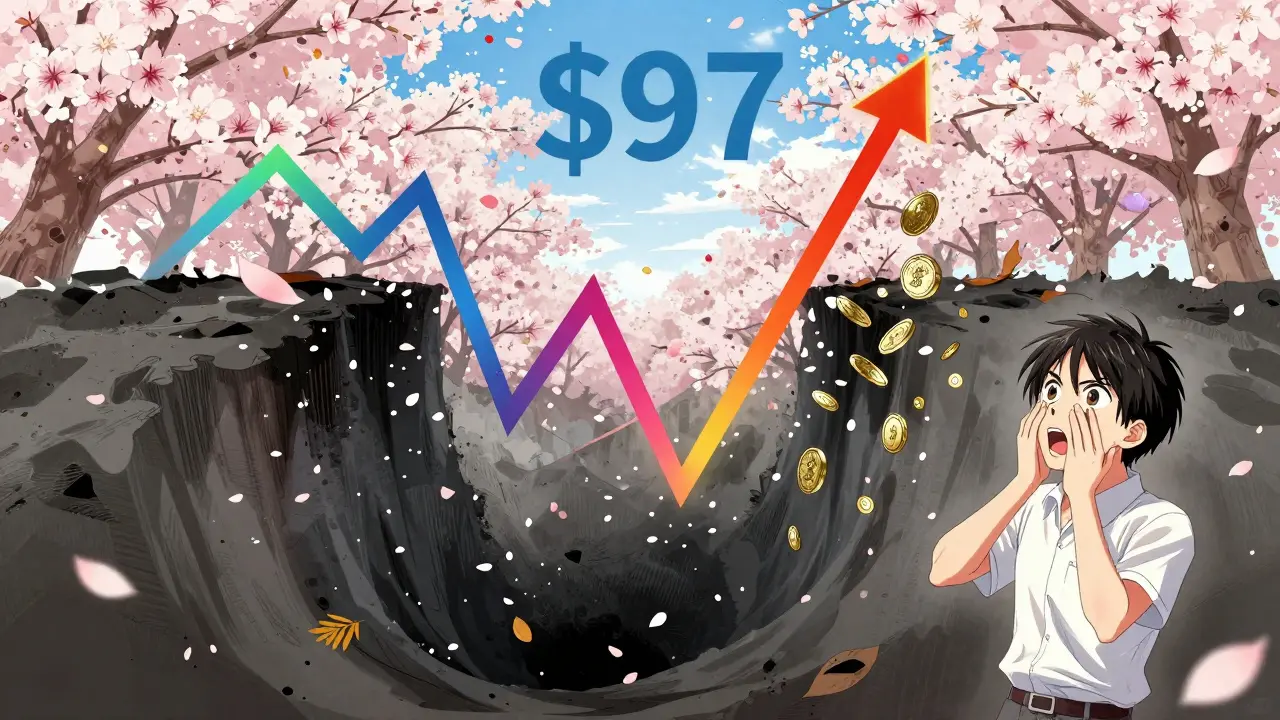
Just 39 days after launch, on March 4, 2014, Auroracoin hit an all-time high of $97.84. At that moment, it seemed like the future of Icelandic finance. But the value was not supported by utility. Few merchants actually accepted it, and most people sold their free airdropped coins for quick profit rather than spending them.
By mid-2026, the reality is starkly different. Recent data shows Auroracoin trading between $0.03 and $0.04 USD. This represents a drop of roughly 99.95% from its peak. The market capitalization is negligible, ranking around #4160 on major trackers like CoinGecko. The daily trading volume is often less than $1, meaning liquidity is extremely low. You could try to sell a large amount of AUR and find no buyers waiting on the other side.
| Metric | Auroracoin (AUR) | Bitcoin (BTC) | Litecoin (LTC) |
|---|---|---|---|
| Block Time | 61 seconds | 10 minutes | 2.5 minutes |
| Total Supply | 21 Million | 21 Million | 84 Million |
| Market Status | Negligible / Low Liquidity | Dominant Reserve Asset | Established Payment Layer |
| Primary Use Case | Historical Experiment | Store of Value | Fast Payments |
Why Did Auroracoin Fail to Adopt?
You might wonder why a currency given away for free didn't stick. Several factors contributed to Auroracoin's decline:
- Lack of Merchant Adoption: For a currency to work, businesses need to accept it. Despite claims that some Icelandic shops took AUR, widespread adoption never happened. The Icelandic króna remained stable enough, and consumers preferred familiar payment methods.
- Sell Pressure from Airdrop: When you give something away for free, people tend to sell it immediately rather than hold or spend it. This created constant downward pressure on the price from day one.
- Development Stagnation: After the initial launch and the 2016 fork, development activity slowed significantly. Without active updates, security patches, or community growth, interest waned.
- Competition: By the time Auroracoin tried to gain traction, Ethereum and other smart contract platforms were emerging. Later, stablecoins and faster layer-2 solutions on Bitcoin and Ethereum offered better utility for payments.
Is Auroracoin Still Alive?
Technically, yes. The blockchain is still running. You can download the Auroracoin Core wallet and run a full node. Transactions still occur, albeit rarely. It is traded on a few niche exchanges like Freiexchange, but these markets are thin and illiquid.
However, "alive" doesn't mean "relevant." There is no significant news coverage, no institutional interest, and no roadmap for future development. It exists in a state of maintenance-only limbo. For investors, holding AUR today is not an investment strategy; it is a nostalgic hold on a piece of crypto history.
Risks of Holding Auroracoin Today
If you somehow acquired Auroracoin through an old wallet or inheritance, you should be aware of the risks:
- Liquidity Risk: With daily volumes under $1, selling even a small amount can crash the local price further. You may not be able to exit your position without significant loss.
- Security Risks: Older codebases that aren't actively maintained can become vulnerable to new types of attacks. While the multi-algorithm mining helps against 51% attacks, lack of software updates poses long-term threats.
- Regulatory Uncertainty: As global regulations tighten around cryptocurrencies, obscure tokens with little oversight are often the first to face delisting from exchanges or legal scrutiny.
Lessons from the Auroracoin Experiment
Auroracoin serves as a cautionary tale for the crypto industry. It proved that giving away tokens doesn't guarantee adoption. Utility, network effects, and continuous development matter far more than a clever marketing stunt or a patriotic narrative.
For those interested in decentralized alternatives to fiat currencies, projects like Bitcoin, Litecoin, or modern stablecoins offer more robust ecosystems. Auroracoin remains a fascinating footnote-a well-intentioned attempt to solve a local problem with global technology that ultimately couldn't overcome human behavior and market forces.
Who created Auroracoin?
Auroracoin was launched by a pseudonymous developer known as Baldur Friggjar Óðinsson. Later reports also credit Myckel Habets, Mikael Hannes, and Martin Jansen with the technical development of the coin.
Is Auroracoin a good investment in 2026?
No. Auroracoin has lost over 99% of its value since its peak. It has negligible trading volume, no active development, and limited utility. It is considered a high-risk asset with no realistic potential for recovery.
Where can I buy Auroracoin?
Auroracoin is available on very few exchanges, such as Freiexchange. However, due to extremely low liquidity, buying or selling large amounts is difficult and may result in significant slippage.
What is the maximum supply of Auroracoin?
The maximum supply of Auroracoin is capped at 21 million coins, similar to Bitcoin. Approximately 20 million are currently in circulation.
How does Auroracoin differ from Bitcoin?
Auroracoin has faster block times (61 seconds vs. 10 minutes), uses multiple mining algorithms to prevent centralization, and was originally distributed via a national airdrop to Icelandic citizens. Bitcoin uses a single algorithm (SHA-256) and has a larger, more established network.
Is Auroracoin still used in Iceland?
No. Despite initial efforts to promote it as an alternative to the Icelandic króna, Auroracoin never gained widespread merchant adoption. The króna remains the primary currency in Iceland.