
What is Baby Elon (BABYELON) Crypto Coin? Full Guide & Risk Analysis
 Aug, 25 2026
Imagine buying a ticket to a concert that hasn't started yet, only to find out the venue was demolished three months ago. That’s roughly what holding Baby Elon (BABYELON) feels like for many early investors. Launched in January 2024 on the Binance Smart Chain, this token promised to ride the wave of the meme coins are speculative digital assets driven by social media hype rather than utility trend. But as we move through mid-2026, the reality is stark: the project has largely vanished from the radar, leaving behind a trail of near-zero liquidity and confused data across tracking platforms.
If you’re looking at BABYELON right now, you’re likely asking two things: Is it worth buying? Or, if you already hold some, how do I get out? This guide breaks down exactly what Baby Elon is, why its numbers look so strange, and what the data tells us about its current viability. We’ll skip the hype and focus on the hard facts you need to make a decision.
Quick Summary / Key Takeaways
- Status: Highly speculative, near-abandoned asset with negligible market cap.
- Liquidity: Effectively zero on major decentralized exchanges; exiting positions is difficult.
- Supply: Massive total supply of 420 quadrillion tokens creates extreme dilution.
- Risk Level: Extreme. Suitable only for those willing to lose 100% of their investment.
- Utility: None apparent. Pure meme coin with no development roadmap or active community.
Technical Specifications: What Makes Up BABYELON?
To understand where we stand, let’s look at the skeleton of the project. Baby Elon is built using the BEP-20 standard on the Binance Smart Chain. This means it operates within the same ecosystem as BNB, allowing for low transaction fees and fast block times. However, being on BSC doesn’t guarantee success; it just provides the infrastructure.
The most striking feature is the token supply. The total supply is set at 420 quadrillion tokens (420,000,000,000,000,000). In crypto terms, this is an astronomical number designed to create a "low price per unit" illusion, common in meme coins. It makes the price look tiny ($0.0000000000004), which can psychologically appeal to buyers hoping for a "10x" or "100x" move. But in practice, such massive supply requires enormous capital inflows to drive any significant price appreciation.
| Attribute | Value | Implication |
|---|---|---|
| Blockchain | Binance Smart Chain (BSC) | Low fees, high speed, but crowded with similar tokens |
| Token Standard | BEP-20 | Compatible with MetaMask, Trust Wallet, etc. |
| Total Supply | 420 Quadrillion | Extreme dilution; high barrier to price growth |
| Contract Address | 0x2589...DD98 | Verify before trading to avoid fake tokens |
| Launch Date | January 3, 2024 | Entered market late in the meme cycle |
Current Market Status: Why the Numbers Don't Add Up
Here’s where it gets confusing. If you check different crypto trackers, you might see wildly different prices for BABYELON. One site might show $0.0000000000007, while another shows $0.0000000000004. Some even list the market cap as $0, while others claim it’s around $311,000. Which one is real?
The short answer is: none of them are fully reliable because the token has almost no liquidity. When there are very few buyers and sellers, the "price" is determined by the last trade, which could have happened days or weeks ago. A single small trade can swing the price by 10% or more, making percentage changes look dramatic even when the absolute value is microscopic.
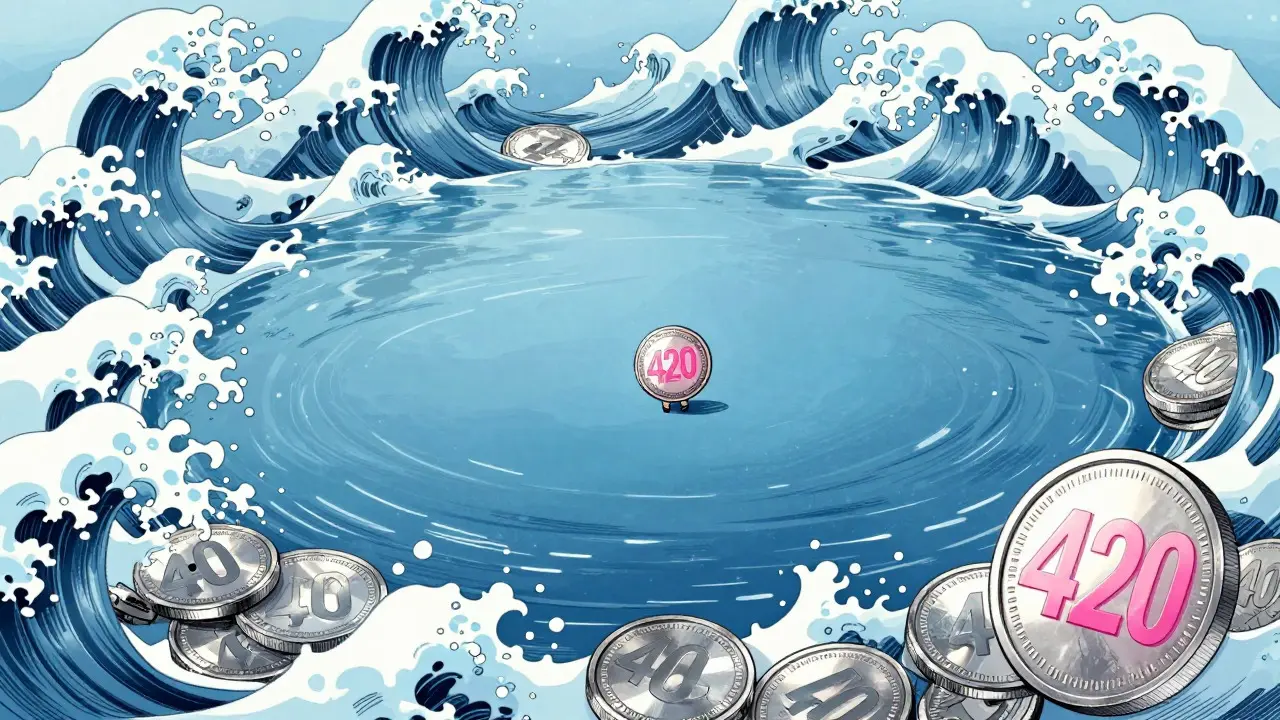
As of mid-2026, the 24-hour trading volume hovers between $0 and $2,000. For context, a mid-tier meme coin like Shiba Inu often sees billions in daily volume. BABYELON’s volume is essentially non-existent. This lack of activity means that if you try to sell a large amount of tokens, you will likely crash the price significantly because there isn’t enough money in the pool to absorb your sale without moving the needle.
Liquidity and Exit Strategy: Can You Actually Sell?
This is the most critical section for anyone holding or considering buying BABYELON. Liquidity refers to how easily you can convert your tokens into stablecoins or other assets without losing much value. For BABYELON, the liquidity situation is dire.
The primary trading pairs are on PancakeSwap v2 and v3. Recent data indicates that the liquidity pools for these pairs are effectively empty or contain negligible amounts of BNB. When liquidity is $0 or near $0, you face two major problems:
- Slippage: To buy or sell, you must accept a high slippage setting. This means you might think you’re selling for $100, but after fees and price impact, you only receive $50.
- Illiquidity Risk: There may simply be no counterparty. If you place an order to sell, it might sit unfilled for days or weeks until someone else decides to buy.
Crypto.com, a major centralized exchange, explicitly states that BABYELON is "not tradable yet" on their platform, despite showing historical price data. This disconnect highlights that the token exists mostly on decentralized exchanges (DEXs) with minimal support from established financial institutions.
Risk Factors: Why Most Analysts Are Pessimistic
Professional prediction platforms have largely given up on forecasting BABYELON’s future. Changelly, for instance, lists price predictions for 2025 through 2050 as $0.00000000. While this might seem like a technical error, it reflects a broader sentiment: the market believes the token has lost its fundamental value drivers.
Let’s break down the specific risks involved in holding this asset:
- No Utility: Unlike projects with staking rewards, governance rights, or DeFi integrations, BABYELON appears to be a pure play on name recognition. Without utility, value depends entirely on new buyers entering the market.
- Community Absence: Active crypto projects thrive on community engagement. BABYELON lacks visible presence on Reddit, Twitter, or Discord. No announcements, no development updates, no marketing campaigns. Silence in crypto usually means abandonment.
- Dilution Pressure: With 420 quadrillion tokens in existence, even if all of them were held by active users, the price per token would remain infinitesimally small unless massive capital flows in.
- Regulatory Uncertainty: As a meme coin with no clear purpose, it sits in a gray area for regulators. While not currently targeted, any crackdown on "useless" tokens could further depress interest.

Comparison: BABYELON vs. Established Meme Coins
To put BABYELON’s performance in perspective, let’s compare it to a successful meme coin like Dogecoin (DOGE). DOGE launched in 2013 and maintains a multi-billion dollar market cap with active trading on major exchanges. BABYELON launched in 2024 and struggles to maintain even a six-figure market cap consistently.
| Feature | BABYELON | DOGE |
|---|---|---|
| Market Cap | Near $0 - $300K (unreliable) | $10B+ (stable) |
| Daily Volume | < $2,000 | $1B+ |
| Exchange Support | PancakeSwap only (limited) | All major CEXs and DEXs |
| Community Size | Unknown/Negligible | Millions of active users |
| Use Case | Meme/Hype | Payments/Tipping/Meme |
The gap is not just in numbers; it’s in ecosystem integration. DOGE is recognized globally, accepted by merchants, and discussed in mainstream media. BABYELON is invisible outside of niche crypto forums. This disparity suggests that BABYELON failed to capture the necessary network effects to sustain long-term value.
Should You Buy or Hold? A Practical Assessment
So, what should you do? If you’re new to crypto, the advice is simple: avoid BABYELON. The risk-to-reward ratio is heavily skewed toward loss. The probability of finding a buyer for your tokens is low, and the probability of the price recovering to previous highs is extremely slim.
If you already hold BABYELON, consider these scenarios:
- Small Position: If it represents less than 1% of your portfolio, you might leave it as a lottery ticket. The cost of monitoring it outweighs the potential gain for most people.
- Significant Position: Try to exit slowly. Use limit orders rather than market orders to minimize slippage. Be prepared for the possibility that you won’t fill your entire position immediately.
- Tax Implications: Remember that even if you don’t sell, unrealized losses can affect your tax strategy depending on your jurisdiction. Consult a tax professional if you have substantial holdings.
For traders, BABYELON offers little opportunity. Scalping requires high volume and tight spreads, neither of which exist here. Swing trading is impossible due to lack of liquidity. Long-term investing requires faith in a project with no roadmap. Unless you enjoy the thrill of gambling on obscure assets, there is little strategic value in engaging with BABYELON.
Frequently Asked Questions
Is Baby Elon (BABYELON) a good investment in 2026?
Most analysts consider it a high-risk, low-probability asset. With near-zero liquidity, no active community, and stagnant market cap, it lacks the fundamental drivers needed for sustainable growth. It is suitable only for speculative traders who can afford to lose their entire stake.
Where can I buy or sell BABYELON?
The primary venues are PancakeSwap v2 and v3 on the Binance Smart Chain. Centralized exchanges like Crypto.com list it but mark it as untradable. Always verify the contract address (0x258903A8e68d5248dE85CF8a0a173d9e046EdD98) before connecting your wallet to avoid scam tokens.
Why does the price differ so much across websites?
Price discrepancies occur because BABYELON has extremely low trading volume. Different platforms update prices based on the last trade they detect, which can vary widely when trades are infrequent. This makes accurate price discovery difficult and unreliable.
Does Baby Elon have any real-world use case?
Currently, no. It is classified purely as a meme coin. There are no documented plans for staking, governance, or integration into DeFi protocols. Its value is derived solely from speculation and brand association with Elon Musk, which is tenuous at best.
How much is the total supply of BABYELON?
The total supply is 420 quadrillion tokens (420,000,000,000,000,000). This massive number is typical for meme coins aiming to keep the per-token price low, but it also means significant capital is required to move the price upward.