
What is Pulse Inu (PINU)? A Guide to the High-Risk Meme Coin
 Jul, 18 2026
Have you ever scrolled through a crypto price tracker and seen a name that looks familiar but feels slightly off? You are not alone. If you are searching for Pulse Inu, also known as PINU, you are likely looking at one of the most confusing corners of the cryptocurrency market right now. It is not just one coin; it is a cluster of different tokens sharing the same ticker symbol, mostly built on the PulseChain network. Some promise staking rewards, others boast about zero transaction taxes, and all of them carry the wild volatility typical of meme coins.
Before you throw money at a chart, you need to understand what you are actually buying. This guide breaks down the reality behind Pulse Inu, separates the hype from the hard data, and helps you decide if this micro-cap asset belongs in your portfolio or your trash bin.
The Identity Crisis: Which PINU Are You Looking At?
The first thing you will notice when researching Pulse Inu is that the data does not add up. That is because there is no single "official" Pulse Inu that everyone agrees on. Instead, you have at least two distinct assets using the PINU ticker on the PulseChain ecosystem, plus a completely unrelated token called Piccolo Inu that also uses the PINU ticker on Ethereum.
This confusion is dangerous. One version of Pulse Inu lists a circulating supply of roughly 230 trillion tokens. Another version claims a total supply of 17.06 trillion. A third variant says the max supply is only 1 trillion. Then there is Piccolo Inu, which has nothing to do with PulseChain but shares the ticker, leading to massive search engine mix-ups.
When you see a price quote for PINU, ask yourself: which contract address is this? The difference between these tokens can mean the difference between holding a worthless asset and one with actual liquidity. Most major aggregators like CoinGecko and CoinMarketCap struggle to keep these separate, often merging data or listing them under slightly different names like "Pulse Inu Token" versus "Pulse Inu." Always check the specific contract address before connecting your wallet.
Tokenomics and Supply Mechanics
Let’s look at the numbers for the most commonly tracked versions. As of mid-2026, one prominent Pulse Inu listing shows a market capitalization of around $30,000 USD. With a circulating supply near 230 trillion PINU, the price hovers around $0.000000001294 per token. This places it outside the top 7,000 cryptocurrencies by market cap, firmly in the "micro-cap" territory.
The tokenomics vary wildly depending on which contract you hold:
- The Deflationary Model: One version features a closed contract, meaning no new tokens can be minted. It includes a buy-and-burn mechanism where project funds purchase PINU from the market and destroy it. This aims to reduce supply over time, theoretically increasing scarcity.
- The Zero-Tax Model: Another variant markets itself as having 0% transaction tax. It burns its liquidity pool tokens (LP tokens) permanently. Burning LP tokens is a common way for meme projects to signal trust, preventing developers from pulling out the liquidity and running away-a move known as a "rug pull."
- The Dividend Model: Some descriptions mention dividends paid in PLS, the native gas token of PulseChain. Holders might receive distributions from transaction fees or treasury allocations, though exact Annual Percentage Yields (APY) are rarely disclosed clearly.
These mechanisms sound sophisticated, but they rely entirely on community participation. Without consistent trading volume, burn mechanisms do not activate, and dividend pools remain empty.
Trading Venues and Liquidity Risks
If you want to buy or sell Pulse Inu, you will likely need to use decentralized exchanges (DEXs). The primary venue mentioned across multiple sources is PulseX V2, where PINU trades against WPLS (wrapped PLS). Other options include Phux and Kanga.
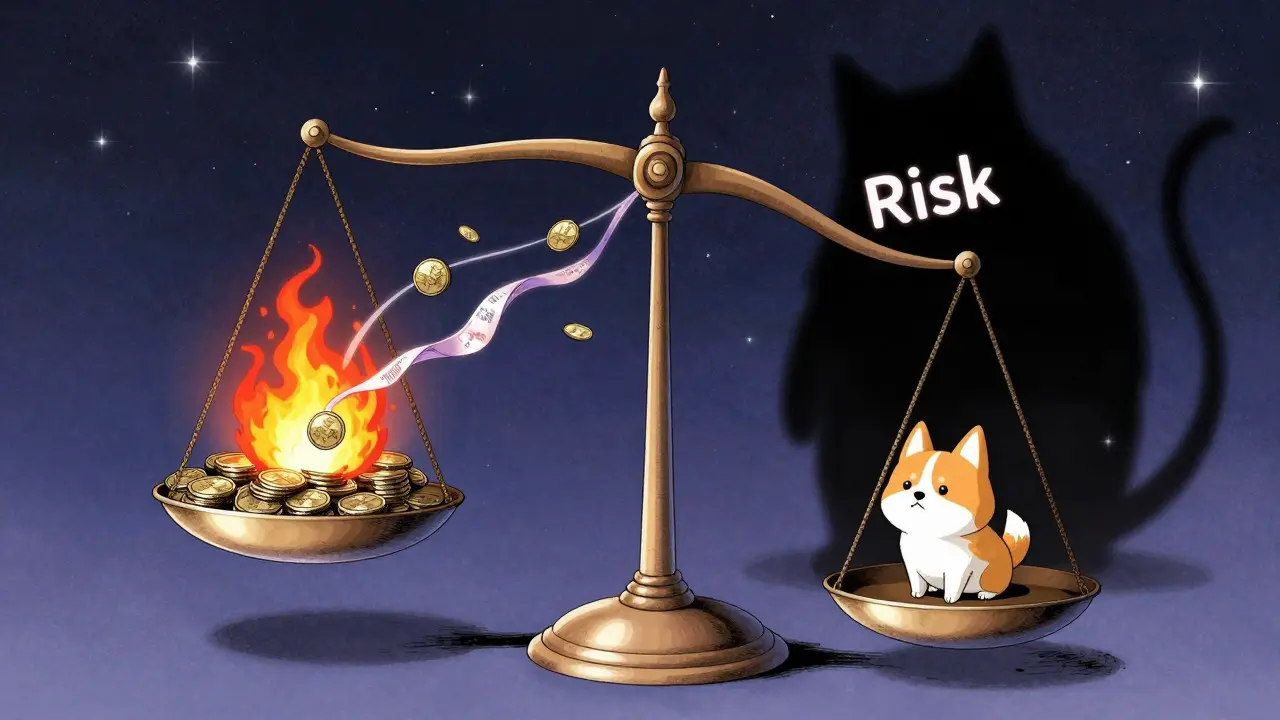
Here is the catch: liquidity is extremely thin. On some days, the 24-hour trading volume for the main PINU/WPLS pair has been reported as low as $1.08 USD. Yes, one dollar. Even on better days, volumes rarely exceed a few hundred dollars. This creates massive slippage risk. If you try to sell a significant amount of PINU, you could crash the price instantly, getting far less than the displayed market value.
Centralized exchanges like Coinbase and Crypto.com list PINU, but with caveats. Coinbase shows a circulating supply of 0 for some listings, indicating no active spot trading. Crypto.com allows swapping via their DeFi interface rather than traditional order books. This means retail investors cannot simply click "buy" on a familiar app; they must navigate the complexities of on-chain swaps.
| Feature | Pulse Inu (Deflationary) | Pulse Inu (Zero-Tax) | Piccolo Inu (Ethereum) |
|---|---|---|---|
| Network | PulseChain | PulseChain | Ethereum |
| Ticker | PINU | PINU | PINU |
| Max Supply | ~230 Trillion | 1 Trillion | 100 Trillion |
| Key Mechanism | Buy & Burn, Staking | 0% Tax, Burned LP | N/A |
| Liquidity Status | Very Low | Low | Separate Market |
Price History and Volatility
Meme coins are notorious for their rollercoaster rides, but Pulse Inu takes this to an extreme. Data from LiveCoinWatch and Coinbase shows that PINU has experienced drawdowns of over 99% from its all-time highs. For instance, one listing recorded an ATH of $0.000038, while current prices sit near $0.000000002. Another variant peaked at $0.00000077 and dropped to $0.0000000049, a 99.36% loss.
This level of depreciation is standard for micro-cap meme coins after the initial hype cycle dies. Early buyers cashed out, leaving latecomers holding bags worth fractions of a cent. While short-term spikes of 7-8% in 24 hours do occur, they are often followed by equally sharp drops. There is no fundamental anchor-no revenue stream, no user base, no utility-to stabilize the price.

How to Buy and Store PINU Safely
If you decide to take the plunge despite the risks, here is how to handle the technical side. Since Pulse Inu lives on PulseChain, you need a compatible wallet. MetaMask is the go-to choice, but you must configure it to recognize the PulseChain network. You will need PLS tokens to pay for gas fees (transaction costs) on the network.
- Set Up Your Wallet: Install MetaMask and add PulseChain as a custom network. Import your seed phrase securely.
- Acquire PLS: Buy PLS on a centralized exchange or bridge ETH from Ethereum to PulseChain. You need this for gas.
- Add PINU Contract: Find the exact contract address for the specific Pulse Inu variant you want. Add it as a custom token in MetaMask to see your balance.
- Swap on DEX: Connect your wallet to PulseX V2 or Phux. Swap PLS for PINU. Be careful with slippage settings; due to low liquidity, you may need to set slippage higher than usual (e.g., 5-10%), but this increases the risk of bad trades.
- Verify Ownership: Double-check that the tokens appear in your wallet and match the correct contract address.
Storing PINU is straightforward since it is an ERC-20-like token on an EVM-compatible chain. However, interacting with staking dApps or NFT platforms associated with PINU requires trusting those smart contracts. Ensure you are using official links from verified community channels, as phishing sites targeting meme coin holders are rampant.
Is Pulse Inu a Good Investment?
Let’s be direct: Pulse Inu is not an investment in the traditional sense. It is a speculative bet on community momentum. The project lacks a transparent founding team, a formal whitepaper, or security audits from reputable firms like CertiK. Growth relies solely on grassroots marketing and social media buzz.
Compare this to established meme coins like Dogecoin or Shiba Inu. Those have billions in market cap, widespread exchange listings, and cultural recognition. Pulse Inu ranks below #7,000, with daily volumes sometimes under $10. The potential for 100x gains exists, but so does the near-certainty of losing everything. The "better pumpamentals" claim made by some promoters is marketing fluff, not financial analysis.
For most people, the answer is no. Treat any money spent on PINU as entertainment budget-cash you are prepared to lose entirely. Only allocate funds that won’t impact your rent, savings, or peace of mind.
What is the real value of Pulse Inu (PINU)?
The intrinsic value of Pulse Inu is effectively zero. Like most meme coins, its price is driven purely by supply and demand dynamics within a small community. It has no underlying cash flow, product, or service backing it. Its market cap fluctuates based on speculative trading activity.
Why are there different supply numbers for PINU?
There are multiple distinct tokens using the PINU ticker on different chains or even different contracts on PulseChain. One might have a supply of 1 trillion, another 230 trillion. Aggregators often mix these up. Always verify the specific contract address to know which supply figure applies to your holdings.
Can I buy Pulse Inu on Coinbase?
While Coinbase lists PINU, trading volume is often near zero, and circulating supply may show as 0 for certain variants. It is primarily traded on decentralized exchanges like PulseX V2. You typically need to swap PLS for PINU on-chain rather than buying it directly with fiat currency on a centralized platform.
Is Pulse Inu safe from rug pulls?
Some versions of Pulse Inu burn their liquidity pool tokens, which prevents developers from withdrawing the underlying assets immediately. However, safety is not guaranteed. Smart contract vulnerabilities, honeypot mechanics (where you can buy but not sell), and developer abandonment still pose significant risks. Always assume high risk.
What is the difference between Pulse Inu and Piccolo Inu?
They are completely different projects. Pulse Inu is built on the PulseChain network. Piccolo Inu is built on Ethereum and trades on platforms like ShibaSwap. They share the PINU ticker symbol, which causes frequent confusion among investors. Check the blockchain network before purchasing.